

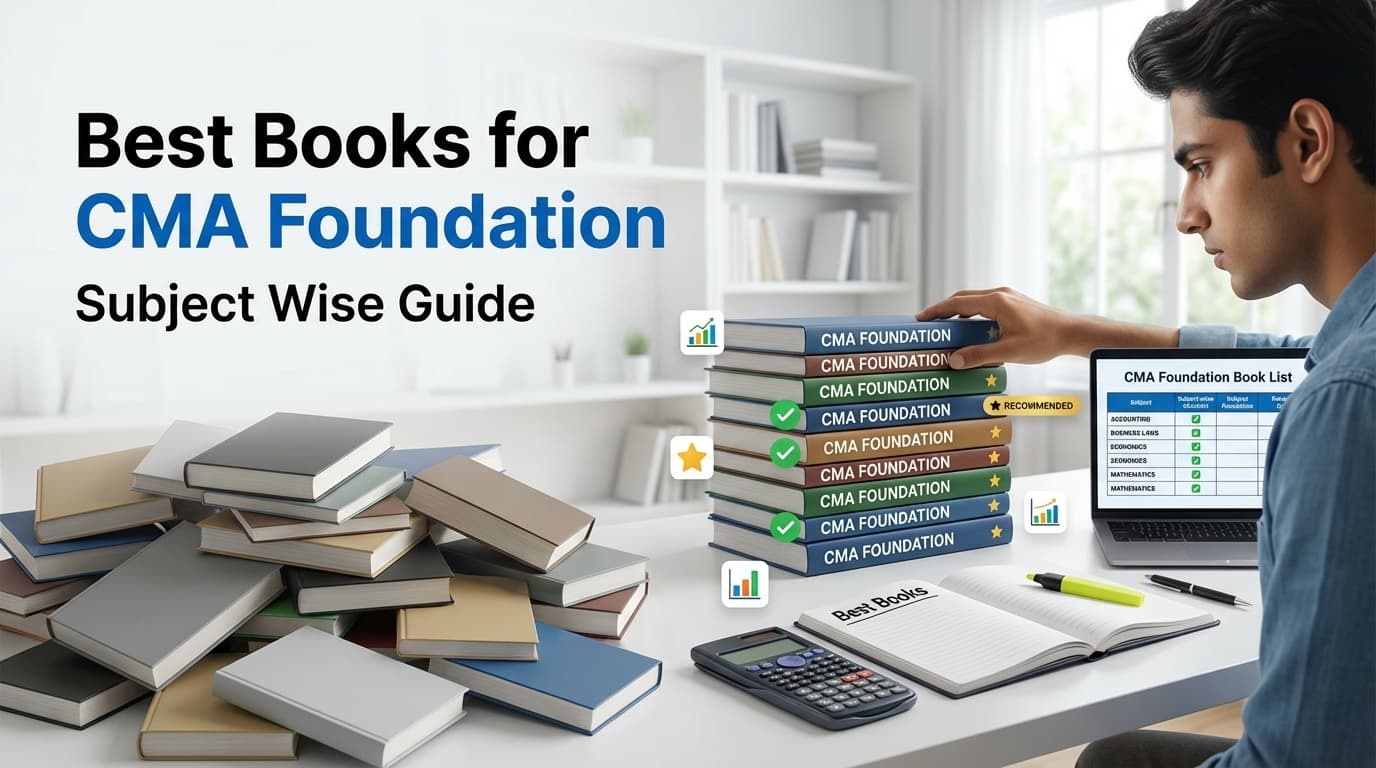
Best Books for CMA Foundation Preparation: A Comprehensive Subject-Wise Guide
Hello, future CMAs! If you are reading this, you have already taken the first step toward a prestigious career in Management Accountancy. At Sachin Ajmera Classes in Jaipur, we have been guiding students for over 23 years, and if there is one thing I have learned, it is this: hard work is essential, but working with the wrong books is like trying to run a marathon in flip-flops. You might get there, but it will be much harder than it needs to be.
The CMA Foundation is your entry point. It sets the base for your Inter and Final levels. Therefore, choosing the right study material is not just about passing; it’s about building a foundation that won't shake later. In this guide, I will walk you through the best books and resources for each subject, based on my decades of experience in the classroom.
1. The Non-Negotiable Start: ICMAI Study Material
Before you look at any private author or fancy reference book, let’s talk about the "Bible" of this course: the ICMAI Study Material provided by the Institute of Cost Accountants of India.
Many students make the mistake of ignoring the Institute's modules, thinking they are too plain or basic. However, the CMA Foundation exam is conducted by the Institute, and they design the paper based on these very books. In my 23 years of teaching, I have seen that almost 80-90% of the concepts and even some direct questions come straight from these modules.
- Expert Tip: Always finish the ICMAI module first. Mark the important illustrations and back-of-chapter MCQs. Treat these as your primary source of truth.
2. Subject-Wise Book Recommendations
Paper 1: Fundamentals of Business Laws and Business Communication
Law is often a new subject for students coming from a pure science or even some commerce backgrounds. It requires understanding the 'intent' of the law, not just memorizing sections.
- Primary Resource: ICMAI Module for Law and Communication.
- Reference Book: For a more simplified explanation of legal jargon, you can refer to Taxmann’s CMA Foundation Law or books by P.C. Tulsian. They break down complex Indian Contract Act and Sale of Goods Act concepts into simpler language.
- Communication: This part is scoring! Focus on the ICMAI module for business communication. It’s concise and sufficient for the exam.
Paper 2: Fundamentals of Financial and Cost Accounting
This is the heart of the CMA course. Since you are going to be a Cost Accountant, your grip on this paper must be rock solid. This paper is a mix of theory and practical problems.
- Primary Resource: ICMAI Module for theory and basic illustrations.
- Reference Book: For extra practice, I highly recommend Hanif and Mukherjee or T.S. Grewal for financial accounting. For Costing basics, the Institute material is usually enough, but you can look at Jawahar Lal for deeper conceptual clarity.
- Faculty Advice: Don’t just practice the math; understand the 'Accounting Standards' and 'Costing Principles.' These are the pillars of your professional career.
Paper 3: Fundamentals of Business Mathematics and Statistics
I know many students dread this paper, especially those who left math after Class 10. But believe me, the math in CMA Foundation is logic-based, not just calculation-based.
- Primary Resource: ICMAI Module. The exercises at the end of each chapter are vital.
- Reference Book: Arun Sharma (for basic quantitative aptitude) can be helpful if you want to learn shortcuts. However, S.C. Gupta is excellent for Statistics.
- Strategy: Statistics is usually easier and more scoring than Mathematics. Focus on measures of central tendency, dispersion, and probability to secure your passing marks first.
Paper 4: Fundamentals of Business Economics and Management
This is a purely conceptual paper. If you understand the 'Why' behind demand curves or management styles, you can clear this easily.
- Primary Resource: ICMAI Module is quite comprehensive for this subject.
- Reference Book: For Management, you can refer to L.M. Prasad if you find the Institute language a bit dense. For Economics, Deepashree provides very student-friendly notes and MCQs.
3. The Secret Ingredient: Scanners and Past Year Papers
At Sachin Ajmera Classes, we tell our students that a "Scanner" is their best friend. A Scanner is a compilation of previous years’ exam questions arranged chapter-wise.
- Recommended: Suchitra Publication’s Scanner for CMA Foundation.
- Why use it? It helps you understand the weightage of each chapter. For example, if you see that 'Consignment Accounts' has appeared in every exam for the last 5 years, you know you cannot skip it.
4. Practical Study Tips from Sachin Ajmera Classes
Having the best books on your shelf won't help unless you have a strategy to use them. Here are a few tips I share with my students in Jaipur:
- Make Own Notes: No matter how good the book is, your own handwritten notes are 10 times more effective during the last 2 days before the exam.
- Focus on MCQs: Since the Foundation level is MCQ-based, practice solving questions within a time limit. Use a stopwatch. Accuracy + Speed = Success.
- Don't Multiple-Source: Don't buy 5 different books for one subject. Pick one reference book and the ICMAI module. Stick to them. Too many books lead to too much confusion.
- Conceptual Revision: In subjects like Law and Economics, don't just 'read'—try to explain the concept to a friend or even to your own reflection in the mirror. If you can explain it, you have learned it.
5. Why Guidance Matters
Self-study is great, but sometimes you need a mentor to tell you what *not* to study. The CMA syllabus is vast, and time is limited. In our 23+ years of coaching at Sachin Ajmera Classes, we have distilled the vast ICMAI syllabus into focused, result-oriented teaching. We provide our own curated study material and notes that simplify the toughest chapters, making it easier for students to score high see demo lecture.
Conclusion
Preparing for the CMA Foundation is about discipline and using the right tools. Start with your ICMAI modules, supplement them with a good reference book like Tulsian or Hanif & Mukherjee where needed, and most importantly, practice from Scanners.
Remember, the goal is not just to pass the exam, but to become a competent Cost and Management Accountant who can add value to any organization. If you ever feel stuck or need guidance in your CMA journey, our doors at Sachin Ajmera Classes in Jaipur are always open for you. Keep studying, keep growing, and keep believing in yourself!