

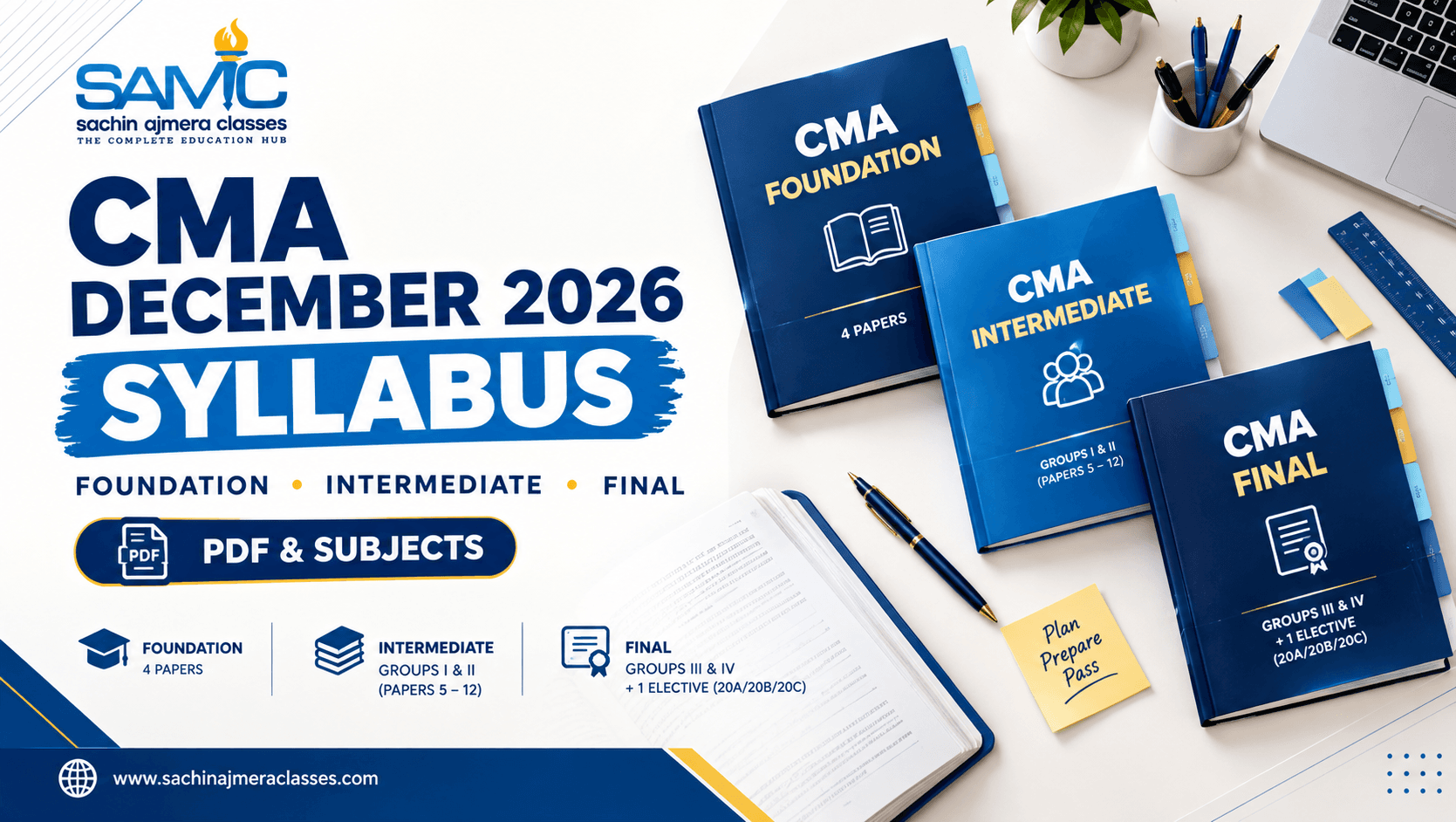
The CMA December 2026 examination is conducted by the Institute of Cost Accountants of India (ICMAI) under Syllabus 2022, which has been in effect since June 2023. This comprehensive guide covers the complete Foundation, Intermediate, and Final syllabus applicable to students appearing in December 2026, along with official PDFs, subject structures, and expert preparation strategies.
CMA December 2026 Syllabus: Quick Overview
| CMA Level | Groups | Total Papers | Total Marks | Syllabus Version |
|---|---|---|---|---|
| Foundation | N/A | 4 | 400 | Syllabus 2022 |
| Intermediate | 2 (Group I & II) | 8 | 800 | Syllabus 2022 |
| Final | 2 (Group III & IV) | 8 (+ 1 Elective) | 800 | Syllabus 2022 |
Students appearing for CMA December 2026 follow the ICMAI Syllabus 2022 across all three levels. The syllabus structure introduced in June 2023 continues unchanged for the December 2026 term. Each paper carries 100 marks, with no negative marking across all three levels, and examinations are conducted in offline, centre-based mode.
CMA Foundation Syllabus December 2026
The CMA Foundation course is the first stage of your CMA qualification journey. It provides foundational knowledge in business laws, accounting, mathematics, statistics, and management principles.
Foundation Course Structure
| Paper | Subject | Full Form | Marks |
|---|---|---|---|
| Paper 1 | Fundamentals of Business Laws and Business Communication | FBLC | 100 |
| Paper 2 | Fundamentals of Financial and Cost Accounting | FFCA | 100 |
| Paper 3 | Fundamentals of Business Mathematics and Statistics | FBMS | 100 |
| Paper 4 | Fundamentals of Business Economics and Management | FBEM | 100 |
| Total | 4 Papers | 400 Marks |
The CMA Foundation exam for December 2026 will be held on December 13, 2026 in a single day across two sessions:
- Morning Session (10:00 AM – 12:00 Noon): Papers 1 & 2
- Afternoon Session (2:00 PM – 4:00 PM): Papers 3 & 4
Each paper consists of 50 multiple-choice questions (MCQs) totaling 100 marks. The exam form deadline for CMA Foundation December 2026 is October 14, 2026 (without late fee).
CMA Foundation Subjects 2026
Paper 1: Fundamentals of Business Laws and Business Communication (FBLC)
This subject covers the legal framework applicable to business in India, including the Indian Penal Code, Indian Contract Act, and essential business communication principles.
Major Topics:
- Introduction to Law and Legal System
- Indian Contract Act, 1872
- Sale of Goods Act, 1930
- Negotiable Instruments Act, 1881
- Business Communication essentials
- Public Relations and Corporate Communication
Preparation Tip: This foundational law subject bridges general legal knowledge with business application. Refer to updated study materials from ICMAI to ensure you're learning current legal provisions.
Paper 2: Fundamentals of Financial and Cost Accounting (FFCA)
Paper 2 introduces double-entry bookkeeping, financial accounting principles, and basic cost accounting concepts essential for management accountants.
Major Topics:
- Financial Accounting fundamentals
- Journal, Ledger, and Trial Balance
- Final Accounts preparation
- Depreciation methods
- Introduction to Cost Accounting
- Cost classification and behavior
Preparation Tip: Strong fundamentals in this paper are critical, as intermediate and final levels build extensively on these concepts.
Paper 3: Fundamentals of Business Mathematics and Statistics (FBMS)
This quantitative subject equips you with mathematical and statistical tools used in management accounting and business decision-making.
Major Topics:
- Arithmetic and Algebraic fundamentals
- Percentages and Ratios
- Simple and Compound Interest
- Permutations and Combinations
- Probability theory
- Statistical measures and distributions
- Correlation and Regression analysis
Paper 4: Fundamentals of Business Economics and Management (FBEM)
Paper 4 covers microeconomic principles, macroeconomic fundamentals, and organizational management theory.
Major Topics:
- Microeconomics (Demand, Supply, Elasticity)
- Consumer behavior and utility theory
- Production and Cost functions
- Market structures
- Macroeconomics basics
- Management principles and functions
- Organizational behavior
Preparation Link: Explore CMA Foundation coaching at SAC to strengthen foundational concepts.
CMA Intermediate Syllabus December 2026
The CMA Intermediate course advances your knowledge in accounting, taxation, law, cost accounting, and strategic management. It consists of 8 papers divided into 2 groups.
CMA Intermediate Course Structure
Group I – CMA Intermediate
| Paper | Subject | Abbreviation | Marks |
|---|---|---|---|
| Paper 5 | Business Laws and Ethics | BLE | 100 |
| Paper 6 | Financial Accounting | FA | 100 |
| Paper 7 | Direct and Indirect Taxation | DITX | 100 |
| Paper 8 | Cost Accounting | CA | 100 |
| Group I Total | 400 Marks |
Group II – CMA Intermediate
| Paper | Subject | Abbreviation | Marks |
|---|---|---|---|
| Paper 9 | Operations Management and Strategic Management | OMSM | 100 |
| Paper 10 | Corporate Accounting and Auditing | CAA | 100 |
| Paper 11 | Financial Management and Business Data Analytics | FMDA | 100 |
| Paper 12 | Management Accounting | MA | 100 |
| Group II Total | 400 Marks |
Exam Dates for December 2026:
- Group I & II Exams: December 10–17, 2026
- Exam Timing: 2:00 PM to 5:00 PM (3 hours per paper)
The CMA December 2026 exam pattern provides detailed information on question types and marking schemes.
CMA Intermediate Subjects 2026
Group I Subjects
Paper 5: Business Laws and Ethics (BLE)
This subject expands on foundation law with deeper coverage of commercial and corporate laws applicable to modern business.
Coverage:
- Indian Contracts Act detailed provisions
- Sale of Goods Act applications
- Negotiable Instruments Act
- Partnership and Company laws
- Limited Liability Partnership Act, 2008
- Labor laws (Factories Act, Gratuity Act, ESI Act, PF Act, Code on Wages)
- Business ethics and emotional intelligence
Paper 6: Financial Accounting (FA)
Financial accounting at the intermediate level covers advanced accounting principles, accounting standards, and consolidated accounts.
Coverage:
- Accounting principles and framework
- Revenue recognition
- Depreciation and impairments
- Investments accounting
- Inventories valuation
- Employee benefits accounting
- Accounting for special transactions
- Consolidated financial statements basics
Paper 7: Direct and Indirect Taxation (DITX)
This merged paper covers both income tax and goods and services tax applicable to individuals, businesses, and companies.
Coverage – Direct Taxation:
- Income Tax Act, 1961 fundamentals
- Heads of Income
- Computation of total income
- Tax liability and deductions
- Assessment procedures
Coverage – Indirect Taxation:
- Goods and Services Tax (GST) basics
- HSN/SAC codes
- GST compliance and returns
Paper 8: Cost Accounting (CA)
This paper provides comprehensive coverage of cost accounting methods and techniques essential for cost management.
Coverage:
- Cost classification and cost behavior
- Material costing and inventory control
- Labor costing
- Overhead allocation
- Process costing
- Job and batch costing
- Marginal costing and break-even analysis
- Standard costing and variance analysis
Group II Subjects
Paper 9: Operations Management and Strategic Management (OMSM)
This strategic subject combines operational efficiency with long-term business strategy.
Coverage:
- Operations management principles
- Production planning and control
- Quality management
- Supply chain management
- Strategic management framework
- Competitive strategy
- Strategic planning and execution
Paper 10: Corporate Accounting and Auditing (CAA)
This paper covers accounting for corporate entities and internal audit fundamentals.
Coverage:
- Corporate accounting principles
- Share capital and reserves accounting
- Dividend distribution
- Accounting for amalgamation and absorption
- Financial reporting requirements
- Introduction to internal audit
- Audit procedures and working papers
Paper 11: Financial Management and Business Data Analytics (FMDA)
A strategic subject combining financial management with modern data analytics capabilities.
Coverage:
- Financial statement analysis
- Time value of money
- Working capital management
- Capital budgeting decisions
- Cost of capital and capital structure
- Dividend policy
- Introduction to data analytics for business decisions
- Data visualization and interpretation
Paper 12: Management Accounting (MA)
This subject integrates cost and management accounting with strategic decision-making.
Coverage:
- Management Accounting framework
- Budgeting and budgetary control
- Flexible budgets and performance analysis
- Standard costing and variance analysis
- Activity-based costing
- Decision-making using accounting information
- Responsibility accounting
Preparation Guidance: View SAC's CMA Intermediate coaching program for comprehensive subject-wise guidance.
CMA Final Syllabus December 2026
The CMA Final course represents the highest level of the CMA qualification. It comprises 8 papers across 2 groups, with one elective paper allowing specialization.
CMA Final Course Structure
Group III – CMA Final
| Paper | Subject | Abbreviation | Marks |
|---|---|---|---|
| Paper 13 | Corporate and Economic Laws | CEL | 100 |
| Paper 14 | Strategic Financial Management | SFM | 100 |
| Paper 15 | Direct Tax Laws and International Taxation | DTLIT | 100 |
| Paper 16 | Strategic Cost Management | SCM | 100 |
| Group III Total | 400 Marks |
Group IV – CMA Final
| Paper | Subject | Abbreviation | Marks |
|---|---|---|---|
| Paper 17 | Cost and Management Audit | CMAD | 100 |
| Paper 18 | Corporate Financial Reporting | CFR | 100 |
| Paper 19 | Indirect Tax Laws and Practice | ITLP | 100 |
| Paper 20 (Elective) | * (Choose One) | * | 100 |
| Group IV Total | 400 Marks |
Elective Options for Paper 20:
- Paper 20A: Strategic Performance Management and Business Valuation (SPMBV)
- Paper 20B: Risk Management in Banking and Insurance (RMBI)
- Paper 20C: Entrepreneurship and Start Up (ENTS)
Exam Dates for December 2026:
- Group III & IV Exams: December 10–17, 2026
- Exam Timing: 10:00 AM to 1:00 PM (3 hours per paper)
CMA Final Subjects 2026
Group III Subjects
Paper 13: Corporate and Economic Laws (CEL)
This subject covers corporate law frameworks and economic regulations affecting business operations.
Coverage:
- Indian Contract Act detailed applications
- Companies Act, 2013 (Capital structure, management, governance)
- Securities Regulation Board of India Act
- Limited Liability Partnership Act
- Key economic laws affecting business
- Competition law
- Insolvency and Bankruptcy Code
Paper 14: Strategic Financial Management (SFM)
This advanced subject integrates financial management with corporate strategy.
Coverage:
- Financial reporting and analysis
- Financial forecasting
- Capital structure optimization
- Dividend decisions
- Working capital strategies
- Investment decisions and capital budgeting
- Foreign exchange management
- Mergers and acquisitions
- Securities analysis and portfolio management
- Business valuation
Paper 15: Direct Tax Laws and International Taxation (DTLIT)
Advanced taxation subject covering complex tax planning and international dimensions.
Coverage:
- Income Tax Act, 1961 (Advanced sections)
- Tax planning for individuals and businesses
- Tax compliance and procedures
- International taxation fundamentals
- Transfer pricing
- Double taxation relief
- GST in international context
Paper 16: Strategic Cost Management (SCM)
Strategic application of cost accounting for competitive advantage and business decisions.
Coverage:
- Advanced cost accounting techniques
- Activity-based management
- Target costing
- Lean manufacturing and cost control
- Throughput accounting
- Decision-making under uncertainty
- Strategic pricing
- Cost management in service sectors
- Value chain analysis
Group IV Subjects
Paper 17: Cost and Management Audit (CMAD)
This subject focuses on auditing principles applied to cost and management accounting systems.
Coverage:
- Cost audit framework and objectives
- Cost audit procedures
- Internal controls in cost systems
- Cost audit working papers
- Audit reports
- Compliance auditing
- Management audit concepts
- Performance auditing
Paper 18: Corporate Financial Reporting (CFR)
Advanced financial reporting covering Indian Accounting Standards and corporate disclosure requirements.
Coverage:
- Indian Accounting Standards (Ind AS)
- Financial statement preparation and presentation
- Revenue recognition (Ind AS 115)
- Financial instruments accounting
- Consolidation principles
- Segment reporting
- Related party transactions
- Corporate governance and disclosures
Paper 19: Indirect Tax Laws and Practice (ITLP)
In-depth coverage of GST and other indirect taxes with practical applications.
Coverage:
- Goods and Services Tax (GST) detailed provisions
- HSN and SAC classification
- Input credit and reconciliation
- GST compliance requirements
- Returns filing
- Assessments and appeals
- Customs and excise basics
- International trade taxation
Paper 20 (Electives) – Choose One:
Paper 20A: Strategic Performance Management and Business Valuation (SPMBV)
Focus on performance measurement systems and business valuation methodologies.
Coverage: Balanced scorecard, key performance indicators, discounted cash flow valuation, comparable valuation methods.
Paper 20B: Risk Management in Banking and Insurance (RMBI)
Specialized knowledge in risk management for financial sector entities.
Coverage: Risk types, Basel frameworks, insurance principles, underwriting, claims management.
Paper 20C: Entrepreneurship and Start Up (ENTS)
Focused on entrepreneurial ventures and startup management.
Coverage: Business model development, funding, financial management for startups, growth strategies.
Comprehensive Learning: Explore CMA Final coaching with SAC for in-depth subject coverage and expert guidance.
CMA Foundation vs Intermediate vs Final Syllabus
| Aspect | Foundation | Intermediate | Final |
|---|---|---|---|
| Papers | 4 | 8 (2 Groups) | 8 (2 Groups + 1 Elective) |
| Total Marks | 400 | 800 | 800 |
| Mark Per Paper | 100 | 100 | 100 |
| Exam Duration | 2 hours per paper | 3 hours per paper | 3 hours per paper |
| Focus | Basic concepts and foundations | Intermediate accounting, taxation, and management | Advanced strategy, taxation, and specialized domains |
| Subject Count | 4 | 8 | 8 |
| Specialization | None | None | Yes (Elective) |
| Complexity Level | Beginner | Intermediate | Advanced |
| Question Format | 100% MCQs | Mix of MCQs and descriptive | Mix of objective and descriptive |
CMA Syllabus 2022: What Students Appearing in December 2026 Should Know
The ICMAI Syllabus 2022 has been the standard framework for CMA examinations from June 2023 onwards. Students appearing in December 2026 will follow this exact syllabus with no changes anticipated.
Key Points About Syllabus 2022:
- Applicability: December 2026 students follow Syllabus 2022 across Foundation, Intermediate, and Final levels.
- Previous Syllabus Status: Syllabus 2016 was discontinued after December 2023. There are no "old" syllabi in effect.
- Structural Changes in 2022:
- Paper renumbering for better logical flow
- Merged subjects (Direct and Indirect Taxation combined in Intermediate)
- New papers introduced (Business Data Analytics)
- Elective options added at Final level
- Official Confirmation: ICMAI has not announced any syllabus changes for December 2026. Syllabus 2022 continues unchanged.
- Study Material Alignment: All current ICMAI study materials, practice papers, and official resources are based on Syllabus 2022.
Important: Always verify the applicability of study materials and previous year question papers by confirming they are marked as "Syllabus 2022." Using materials from older syllabi may create knowledge gaps.
CMA December 2026 Syllabus PDF Download
Official CMA Syllabus PDFs from ICMAI
The Institute of Cost Accountants of India (ICMAI) provides official curriculum documents and study materials on their Students' Portal:
Official PDFs Available:
- Foundation Curriculum 2022 - Available at ICMAI Students' Portal (studies.icmai.in)
- Intermediate Curriculum 2022 - Group I and Group II separate documents
- Final Curriculum 2022 - Group III and Group IV separate documents
Direct Access:
- Visit: https://icmai.in/studentswebsite
- Navigate to: Syllabus 2022 section
- Download: Foundation, Intermediate, and Final curriculum PDFs
ICMAI Study Materials
ICMAI also provides detailed study materials for each paper under Syllabus 2022:
- Foundation Study Materials (Paper-wise)
- Intermediate Study Materials (Group-wise)
- Final Study Materials (Group-wise)
Important Note on Syllabus Documents
The official ICMAI PDF is the authoritative source for the complete syllabus. These documents detail:
- Complete chapter-wise structure
- Learning objectives for each topic
- Depth and breadth of coverage
- Recommended study approach per paper
Recommendation: Download official ICMAI syllabi to understand the exact scope before beginning your preparation. Third-party interpretations may miss crucial details.
How to Use the CMA December 2026 Syllabus for Preparation
Understanding the syllabus is the foundation of effective CMA preparation. Here's how to transform the syllabus into a winning preparation strategy:
1. Break Down the Syllabus into Topics
- Convert each paper's syllabus into granular topics
- Create a master checklist of all topics across papers
- Assign a difficulty level (Easy, Medium, Hard) to each topic
2. Divide Topics into Weekly Targets
- Calculate total weeks available until December 2026
- Allocate topics proportionally across weeks
- Schedule harder topics when your focus is peak
- Plan revision weeks before the exam
3. Map Syllabus to Study Materials
- Match each syllabus topic with study material chapters
- Identify which textbook/source covers each topic
- Note additional resources for complex areas
- Cross-reference with practice papers
4. Create a Topic Completion Tracker
- Maintain a progress sheet marking topics completed
- Update status weekly (Not Started, In Progress, Completed, Revised)
- Identify lagging areas for additional focus
- Track weak topics for revision priority
5. Align with Previous Year Questions
- Download CMA December 2024 and June 2024 question papers (Syllabus 2022)
- Map each question to specific syllabus topics
- Identify high-frequency topics (likely to repeat)
- Note low-frequency topics requiring minimal focus
6. Design Your Revision Strategy
- Allocate 20% of total preparation time for revision
- Focus revision on high-frequency topics
- Use practice papers for final-week revision
- Schedule mock tests covering entire syllabus
CMA Syllabus With Previous Year Question Papers
Previous year question papers (PYQs) are invaluable for CMA preparation, but they must be used strategically alongside the syllabus.
Why Combine Syllabus and PYQs?
- Understand Question Patterns: See how examiners convert syllabus topics into questions
- Identify Weightage: Recognize which topics appear frequently
- Learn Presentation Styles: Understand how answers should be structured
- Build Confidence: Practice with actual exam-level questions
- Spot Knowledge Gaps: Identify topics where you lack clarity
Effective Approach:
Step 1: Study 2-3 chapters from syllabus thoroughly Step 2: Attempt related questions from PYQs Step 3: Review answer logic and presentation Step 4: Note frequently tested areas Step 5: Create a summary of important concepts Step 6: Move to next chapter set
Where to Find Official Papers:
Official CMA Foundation and CMA Intermediate/Final previous year papers (December 2024, June 2024, December 2023) are available on the ICMAI Students' Portal under "Question Papers."
Important Warning:
Ensure you're practicing papers from Syllabus 2022 only. Papers before June 2023 follow Syllabus 2016 and may have outdated content, especially in law and taxation papers.
CMA December 2026 Syllabus vs Exam Pattern: Key Difference
Many students confuse syllabus with exam pattern. Understanding the distinction is critical for effective preparation.
Syllabus = What You Study
The syllabus defines content scope:
- Which topics you must study
- Which chapters are included
- What depth of knowledge is expected
- Complete list of subjects and sub-topics
Exam Pattern = How You're Tested
The exam pattern defines test structure:
- Question types (MCQs, descriptive, case studies)
- Number of questions per paper
- Total marks and mark distribution
- Time duration per paper
- Negative marking (if any)
- Difficulty progression
CMA December 2026 Exam Pattern – Foundation Example
| Aspect | Details |
|---|---|
| Mode | Offline, Centre-based |
| Papers | 4 (all on same day – Dec 13) |
| Question Type | 100% Multiple Choice (OMR) |
| Marks per Paper | 100 (50 questions × 2 marks each) |
| Duration per Paper | 2 hours |
| Negative Marking | NO |
| Sessions | Morning (10 AM-12 PM): Papers 1, 2; Afternoon (2 PM-4 PM): Papers 3, 4 |
Connect Syllabus to Exam Pattern:
Because the CMA Foundation exam is 100% MCQ-based, your preparation strategy should emphasize:
- Quick concept recall (not deep derivations)
- Multiple interpretation handling (recognize correct vs. incorrect reasoning)
- Time management (complete 50 questions in 120 minutes)
- Precision over elaboration
For detailed CMA December 2026 exam pattern guidance, refer to official ICMAI notifications and SAC's expert analysis.
CMA December 2026 Syllabus: Latest Updates
As of September 2026, no syllabus changes have been announced for the December 2026 CMA examination. The Syllabus 2022 continues to apply unchanged across all three levels.
What Remained Consistent:
- Paper Structure: All paper names and numbers remain unchanged
- Group Distribution: Intermediate and Final group structures unchanged
- Subject Coverage: No topics have been added or removed
- Elective Options: All three Final electives (Paper 20A, 20B, 20C) continue
Recent Official Clarifications:
ICMAI's latest circulars (as of August-September 2026) confirm:
- December 2026 examination will follow Syllabus 2022
- All amendments up to August 2026 are applicable (especially for law and taxation papers)
- No changes to paper structure or marking scheme
Amendments Applicable to December 2026:
Students should ensure they're learning latest amendments in:
- Income Tax Laws: Latest Finance Acts amendments
- GST Provisions: Recent ministry notifications
- Companies Act: Updated regulations
- Labor Laws: Current statutory requirements
Recommendation: Download the latest ICMAI study materials and circulars to ensure you're learning current law provisions and recent amendments.
Common Mistakes Students Make While Using the CMA Syllabus
Avoiding these syllabus-related mistakes can significantly improve your preparation outcome:
Mistake 1: Using Outdated Syllabus PDFs
Problem: Preparing from Syllabus 2016 materials when Syllabus 2022 applies Impact: Missing new topics, studying deleted chapters Solution: Always confirm "Syllabus 2022" on downloaded materials
Mistake 2: Ignoring Syllabus Depth Indicators
Problem: Studying every topic with equal depth Impact: Wasting time on minor topics, insufficient depth on major areas Solution: ICMAI syllabus documents indicate topic weightage; prioritize accordingly
Mistake 3: Preparing Without the Official PDF
Problem: Relying only on third-party interpretations Impact: Missing nuances, misunderstanding scope, knowledge gaps Solution: Download and study official ICMAI curriculum PDFs as primary reference
Mistake 4: Not Mapping Syllabus to Practice Papers
Problem: Attempting practice questions without knowing their syllabus connection Impact: Unable to identify weak topics, ineffective revision Solution: Create a syllabus-to-questions map for each paper
Mistake 5: Skipping Syllabus Updates and Amendments
Problem: Studying static content without recent legal/regulatory amendments Impact: Answering outdated questions, missing current law applications Solution: Subscribe to ICMAI circulars, check for annual amendments
Mistake 6: Treating Syllabus as Complete Study Guide
Problem: Thinking syllabus alone is sufficient for exam success Impact: Memorizing topics without understanding depth required Solution: Use syllabus as framework; supplement with textbooks, case studies, and practice
Mistake 7: Overcomplicating Simple Topics
Problem: Over-preparing foundational topics beyond syllabus scope Impact: Time wasted, opportunity cost on harder topics Solution: Use syllabus to understand required depth; avoid going beyond
Mistake 8: Not Tracking Syllabus Completion Progress
Problem: Preparing without knowing which topics remain Impact: Unprepared areas at exam time, poor time allocation Solution: Maintain syllabus completion tracker with dates
FAQs on CMA December 2026 Syllabus
1. What is the CMA syllabus for December 2026?
The CMA December 2026 examination follows Syllabus 2022 across Foundation (4 papers), Intermediate (8 papers in 2 groups), and Final (8 papers + 1 elective in 2 groups). This syllabus has been in effect since June 2023 and continues unchanged for December 2026.
2. Which syllabus applies to CMA December 2026?
Syllabus 2022 is the only syllabus applicable for CMA December 2026. Syllabus 2016 was discontinued after December 2023 and is no longer relevant.
3. Is CMA Syllabus 2022 applicable for December 2026?
Yes, CMA Syllabus 2022 is fully applicable for December 2026 examinations at all three levels. No changes have been announced.
4. Where can I download the CMA syllabus PDF?
Official CMA syllabi can be downloaded from the ICMAI Students' Portal at https://icmai.in/studentswebsite. Navigate to "Syllabus 2022" and select Foundation, Intermediate, or Final documents.
5. What are the CMA Foundation subjects 2026?
The four CMA Foundation subjects for December 2026 are:
- Paper 1: Fundamentals of Business Laws and Business Communication (FBLC)
- Paper 2: Fundamentals of Financial and Cost Accounting (FFCA)
- Paper 3: Fundamentals of Business Mathematics and Statistics (FBMS)
- Paper 4: Fundamentals of Business Economics and Management (FBEM)
6. What are the CMA Intermediate subjects?
CMA Intermediate has 8 subjects divided into two groups:
- Group I: Business Laws and Ethics (P-5), Financial Accounting (P-6), Direct and Indirect Taxation (P-7), Cost Accounting (P-8)
- Group II: Operations Management and Strategic Management (P-9), Corporate Accounting and Auditing (P-10), Financial Management and Business Data Analytics (P-11), Management Accounting (P-12)
7. What are the CMA Final subjects?
CMA Final has 8 compulsory papers plus 1 elective:
- Group III: Corporate and Economic Laws (P-13), Strategic Financial Management (P-14), Direct Tax Laws and International Taxation (P-15), Strategic Cost Management (P-16)
- Group IV: Cost and Management Audit (P-17), Corporate Financial Reporting (P-18), Indirect Tax Laws and Practice (P-19), Elective (P-20A/20B/20C)
8. How many papers are there in CMA Foundation?
CMA Foundation has 4 papers totaling 400 marks.
9. How many papers are there in CMA Intermediate?
CMA Intermediate has 8 papers (in 2 groups) totaling 800 marks.
10. How many papers are there in CMA Final?
CMA Final has 8 compulsory papers plus 1 elective totaling 800 marks.
11. Are CMA syllabus and exam pattern the same?
No, syllabus and exam pattern are different:
- Syllabus = What content you study
- Exam pattern = How you're tested (question types, duration, marks)
12. Has the CMA syllabus changed for December 2026?
No, the CMA syllabus has not changed for December 2026. Syllabus 2022 continues unchanged since its introduction in June 2023.
13. Where can I find the official CMA syllabus?
The official CMA Syllabus 2022 is available on the ICMAI official website at https://icmai.in under the Students' Portal and Syllabus 2022 section.
14. Is the CMA syllabus PDF available on ICMAI?
Yes, ICMAI provides complete curriculum PDFs for Foundation, Intermediate, and Final courses. Download them from the official ICMAI Students' Portal.
15. Can I use the 2026 CMA syllabus for December 2026?
Yes, the 2026 CMA Syllabus (which is Syllabus 2022) applies fully to December 2026 examinations.
16. How should I prepare according to the CMA syllabus?
- Download official ICMAI syllabus PDFs
- Break syllabus into manageable topics
- Create a week-wise preparation schedule
- Study using official textbooks and materials
- Practice with syllabus-mapped previous year papers
- Track completion progress
- Allocate time for revision
17. Can previous-year papers help with syllabus preparation?
Yes, previous year papers are extremely useful to understand:
- How syllabus topics are tested
- Question patterns and difficulty levels
- Topic-wise weightage
- Answer presentation styles
18. What is the total marks for CMA Foundation, Intermediate, and Final?
- Foundation: 400 marks (4 papers × 100 marks)
- Intermediate: 800 marks (8 papers × 100 marks)
- Final: 800 marks (8 papers × 100 marks including elective)
19. How do I know which elective to choose in CMA Final?
Choose based on your career interest:
- Paper 20A (SPMBV): For corporate finance and valuation roles
- Paper 20B (RMBI): For banking and insurance sector careers
- Paper 20C (ENTS): For entrepreneurship and startup aspirations
You select the elective at the time of Final course enrollment.
20. Are there any recent amendments to CMA syllabus?
While the overall Syllabus 2022 structure remains unchanged, specific subject content is updated with:
- Latest tax amendments
- Recent legal provisions
- Current accounting standards
- Updated regulations
Always use latest ICMAI materials to learn these amendments.
21. What study materials should I use with the CMA Syllabus?
Use:
- Official ICMAI Study Materials (primary reference)
- Authorized ICMAI Textbooks (for depth)
- CMA Coaching Institute Materials (supplementary)
- Previous Year Papers (practice and understanding)
- Practice Test Series (comprehensive testing)
22. How long should CMA syllabus preparation take?
Recommended preparation duration:
- Foundation: 6-8 months of consistent study
- Intermediate: 9-12 months (after Foundation)
- Final: 12-15 months (after Intermediate clearance)
The comprehensive CMA syllabus requires dedicated, structured preparation over an extended period.
Conclusion: Your CMA December 2026 Preparation Starts Here
The CMA December 2026 Syllabus 2022 is comprehensive, well-structured, and clearly defined by ICMAI. Success requires:
- Understanding the complete syllabus structure across all three levels
- Obtaining official ICMAI curriculum documents
- Creating a detailed preparation schedule aligned with the syllabus
- Studying using authorized materials and latest amendments
- Practicing with syllabus-mapped previous year questions
- Tracking progress systematically across all papers
- Revising thoroughly in the final weeks before December 2026
Start with the official syllabus PDF, create your preparation roadmap, and commit to consistent, structured study. The path to CMA success is clear—the syllabus has shown you exactly what you need to learn.
For personalized guidance on syllabus-based CMA preparation strategy and expert faculty support, consider joining SAC's comprehensive coaching programs. With 23+ years of CMA teaching experience, SAC provides the structured guidance needed to master this detailed syllabus and excel in the December 2026 examination.