

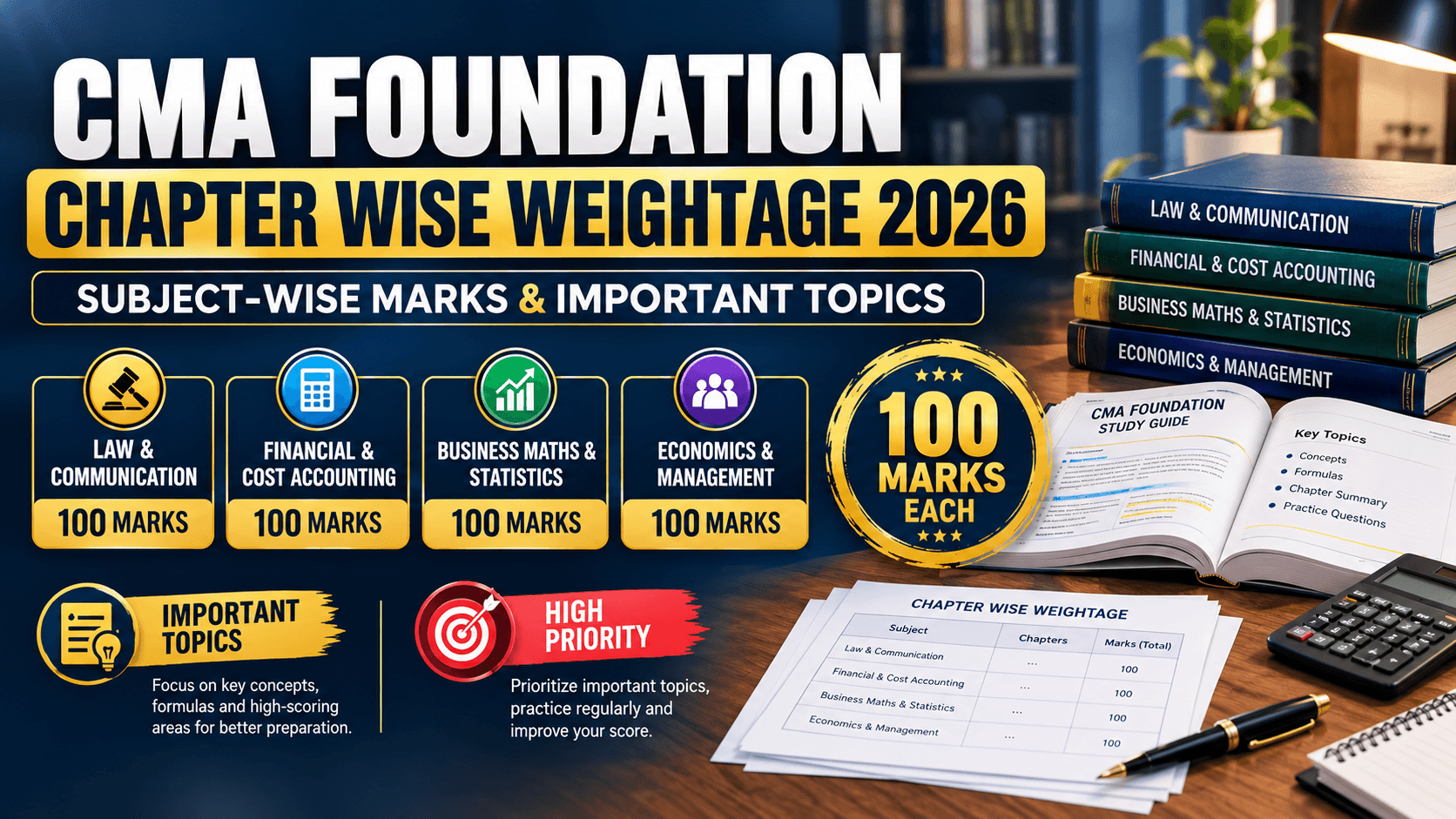
When students search for "CMA Foundation chapter wise weightage," they usually mean one thing: which chapters and topics deserve the most study time before the exam. Here's the direct answer — ICMAI does not publish a fixed, official chapter-by-chapter percentage weightage for CMA Foundation under the current Syllabus 2022. What ICMAI does publish officially is the paper-wise mark distribution (400 total marks across four papers) and the complete syllabus content for each paper. Anything beyond that — which topics tend to carry more questions, which chapters show up more consistently across past sessions — is preparation-priority analysis, not an ICMAI-notified number. This guide gives you both: the official structure, and a clearly labelled, honest breakdown of where previous-paper trends suggest you should focus first.
Quick Answer Box
What is the chapter wise weightage of CMA Foundation 2026? ICMAI does not release official chapter-wise percentage weightage for CMA Foundation. It publishes the paper-wise mark distribution (100 marks per paper) and the full syllabus content; topic-level priority is based on previous-paper trend analysis, not an official ICMAI figure.
Does ICMAI release official chapter-wise weightage for CMA Foundation? No. ICMAI notifies the syllabus and paper-wise marks (400 total, 100 per paper) but does not publish a fixed percentage weightage per chapter for the current Syllabus 2022 structure.
Which subject has the highest weightage in CMA Foundation? All four papers carry equal weightage — 100 marks each. No single subject is weighted higher than another at the paper level.
How many marks is the CMA Foundation exam? 400 marks in total: four papers of 100 marks each, all objective (MCQ), with 50 questions per paper.
Is CMA Foundation difficult to clear? It's manageable with structured preparation — the challenge is breadth and speed (50 MCQs per paper in roughly an hour) rather than descriptive writing difficulty.
Are previous year papers important for chapter-level prioritisation? Yes — since ICMAI doesn't publish chapter weightage, solving previous papers is the most reliable way to observe which topics recur most often.
Key Takeaways
- CMA Foundation 2026 has 4 papers, 400 total marks, 100 marks per paper, all MCQ-based.
- ICMAI does not publish official chapter-wise weightage — only paper-wise marks and full syllabus content.
- "High priority" topics in this guide are based on syllabus structure and previous-paper trend, clearly separate from official ICMAI data.
- No paper carries more weight than another — balanced preparation across all four is essential since there's no exemption at this level.
- Use previous year papers, not assumed percentages, to validate which topics need more practice time.
CMA Foundation Exam Pattern and Marks Distribution 2026
Before chapter-level priority makes sense, the exam pattern needs to be clear. CMA Foundation 2026 continues under Syllabus 2022, the same structure applicable since June 2023.
| Particulars | Details |
|---|---|
| Conducting Body | Institute of Cost Accountants of India (ICMAI) |
| Total Papers | 4 |
| Total Marks | 400 (100 per paper) |
| Question Type | 100% Objective (MCQ) |
| Questions per Paper | 50 (2 marks each) |
| Negative Marking | None |
| Passing Criteria | 40% per paper + 50% aggregate |
| Exam Frequency | Twice a year — June and December |
For the complete breakdown of exam duration, marking scheme, and session structure, see our detailed CMA Foundation exam pattern guide. For the passing criteria explained in depth, our CMA Foundation passing marks guide covers exactly what you need to clear each paper.
Table 1: Paper-wise Overview
| Paper | Subject | Marks | Major Areas | Preparation Priority |
|---|---|---|---|---|
| Paper 1 | Fundamentals of Business Laws and Business Communication (FBLC) | 100 | Indian Contract Act, Sale of Goods Act, Negotiable Instruments Act, Business Communication | High — Law topics repeat consistently across sessions |
| Paper 2 | Fundamentals of Financial and Cost Accounting (FFCA) | 100 | Accounting fundamentals, final accounts, cost sheet basics | High — foundational for Intermediate-level accounting too |
| Paper 3 | Fundamentals of Business Mathematics and Statistics (FBMS) | 100 | Ratios, interest, algebra, statistics (central tendency, dispersion, probability) | Medium-High — statistics carries more weight than mathematics within this paper |
| Paper 4 | Fundamentals of Business Economics and Management (FBEM) | 100 | Micro/macro economics, market structures, management process | Medium — conceptual clarity matters more than memorisation |
All four papers are equally weighted at 100 marks. There is no grouping or exemption system at the Foundation level, which means a weak paper can hold back your overall result even if the other three are strong.
CMA Foundation Chapter Wise Weightage 2026 – Paper 1
Paper 1 (FBLC) combines Business Laws and Business Communication. Within the syllabus structure, Business Laws carries the larger share of this paper, with Business Communication forming a smaller but still scoring section.
Table 2: Paper 1 — Topic Priority
| Chapter/Topic | Priority | Why It Matters | What to Prepare |
|---|---|---|---|
| Indian Contract Act, 1872 | High | Core legal framework — offer, acceptance, consideration, capacity, free consent, discharge, breach — appears across nearly every session based on past papers | Focus on definitions, illustrations, and case-style MCQs |
| Sale of Goods Act, 1930 | High | Frequently tested on conditions vs warranties, transfer of ownership, and rights of unpaid seller | Practice distinguishing similar-sounding legal terms |
| Negotiable Instruments Act, 1881 | Medium | Smaller section but consistently appears — cheque, promissory note, bill of exchange distinctions | Memorise definitions and key differences clearly |
| Business Communication | Medium | Covers communication principles, barriers, and business correspondence | Revise concepts once thoroughly; low volume of marks relative to Law |
Note: These priority labels reflect syllabus structure and previous-paper trend, not an ICMAI-published percentage. Treat "High priority" as "prepare thoroughly and revise more than once," not "guaranteed to appear."
CMA Foundation Chapter Wise Weightage 2026 – Paper 2
Paper 2 (FFCA) covers Financial Accounting and Cost Accounting fundamentals, with Financial Accounting forming the larger portion of the paper.
Table 2: Paper 2 — Topic Priority
| Chapter/Topic | Priority | Why It Matters | What to Prepare |
|---|---|---|---|
| Accounting Fundamentals (concepts, journal, ledger, trial balance) | High | Foundation for every subsequent accounting topic — questions test both concept and calculation | Practice the full journal-to-trial-balance flow repeatedly |
| Final Accounts Preparation | High | High-scoring but calculation-heavy — trading account, P&L, balance sheet | Solve full-length problems under timed conditions |
| Rectification of Errors & Bank Reconciliation | Medium | Recurs across sessions in a predictable question style | Practice standard error types and reconciliation formats |
| Fundamentals of Cost Accounting (cost sheet, classification of costs) | Medium | Smaller weight within this paper but directly relevant to CMA Intermediate | Learn the cost sheet format thoroughly — it's reused at higher levels |
This paper is also the one where accuracy under time pressure matters most — a meaningful share of MCQs test conceptual definitions, not just numbers, so don't assume it's a purely calculation-based paper.
CMA Foundation Chapter Wise Weightage 2026 – Paper 3
Paper 3 (FBMS) covers Business Mathematics and Statistics, with Statistics carrying a larger share of the paper than Mathematics.
Table 2: Paper 3 — Topic Priority
| Chapter/Topic | Priority | Why It Matters | What to Prepare |
|---|---|---|---|
| Measures of Central Tendency & Dispersion | High | One of the most consistently tested statistics topics — mean, median, mode, standard deviation | Practice a wide range of numerical variations |
| Ratios, Interest & Progressions (Arithmetic) | High | Frequently appears and is scoring once the method is clear | Build speed through repeated practice, not just formula memorisation |
| Probability | Medium | Smaller section but tests logical application, not just formulas | Focus on independent/dependent events and basic theorem application |
| Correlation & Regression | Medium | Less frequent but still examinable | Understand the concept behind the formula, not just the formula itself |
| Algebra (sets, indices, permutations) | Medium | Foundational but generally lower question volume than Statistics | Cover basics thoroughly; don't over-invest time here relative to Statistics |
Because this paper is entirely numerical, speed and accuracy under timed conditions matter more here than in any other Foundation paper.
CMA Foundation Chapter Wise Weightage 2026 – Paper 4
Paper 4 (FBEM) covers Business Economics and Fundamentals of Management, with Economics forming the larger share of the paper.
Table 2: Paper 4 — Topic Priority
| Chapter/Topic | Priority | Why It Matters | What to Prepare |
|---|---|---|---|
| Demand, Supply & Market Structures | High | Core microeconomics — consistently tested across sessions | Build conceptual clarity through graphs and real-world examples |
| Theory of Production & Cost | Medium-High | Frequently paired with demand-supply questions | Understand the logic, not just definitions |
| Money and Banking | Medium | Recurs steadily; conceptual rather than numerical | Focus on functions of money, banking systems, and credit control |
| Management Process (planning, organising, leadership, decision-making) | Medium | Broad but relatively straightforward once concepts are clear | Link theories to simple real-life examples for easier recall |
Economics in particular becomes easier to retain when connected to real-world context — tracking how prices or interest rates move helps the theory stick better than pure memorisation.
CMA Foundation Important Topics 2026
Bringing the paper-wise priorities together, here's a consolidated view of where previous-paper trends suggest the heaviest focus should go:
- Paper 1 (FBLC): Indian Contract Act, Sale of Goods Act
- Paper 2 (FFCA): Accounting fundamentals, final accounts preparation
- Paper 3 (FBMS): Central tendency & dispersion, arithmetic (ratios, interest)
- Paper 4 (FBEM): Demand-supply theory, market structures
These are not guaranteed questions — they are patterns observed across previous sessions. ICMAI can and does test any part of the syllabus, so "important" should be read as "prepare first and revise more often," never as "skip the rest."
Which CMA Foundation Chapters Should You Study First?
A practical way to sequence your preparation, without assuming any topic is guaranteed to appear:
High Priority (study and revise multiple times)
- Indian Contract Act, 1872 (Paper 1)
- Accounting Fundamentals and Final Accounts (Paper 2)
- Measures of Central Tendency & Dispersion (Paper 3)
- Demand, Supply & Market Structures (Paper 4)
Medium Priority (cover thoroughly, revise once or twice)
- Sale of Goods Act, Negotiable Instruments Act (Paper 1)
- Rectification of Errors, Cost Sheet Basics (Paper 2)
- Probability, Correlation & Regression, Algebra (Paper 3)
- Money & Banking, Management Process (Paper 4)
Revision Priority (cover once, keep in your final-week revision list)
- Business Communication (Paper 1)
- Bank Reconciliation formats (Paper 2)
- Algebra sub-topics like permutations and indices (Paper 3)
- Theories of leadership and motivation (Paper 4)
This is a study sequencing tool, not a prediction. Every topic in the official syllabus is examinable, and under an all-MCQ format, gaps in "low priority" topics can still cost marks.
How to Use Previous Year Papers to Understand Topic Trends
Since ICMAI doesn't publish chapter-level weightage, previous year papers are the closest thing students have to real evidence of which topics get tested more often. Solving genuine past papers — not random unverified PDFs — lets you observe question patterns directly instead of relying on assumptions.
A structured approach:
- Solve a full previous paper under timed conditions, one paper per subject at a time.
- Note which chapters each question came from — build your own simple tally over several papers.
- Cross-check your observation against the syllabus structure, not the other way around.
- Treat repeated patterns as a signal to revise those topics more often, not as guaranteed exam content.
For genuine, syllabus-matched practice material, our previous year CMA Foundation question papers guide covers exactly how to source and use these papers effectively. You can also explore our CMA Foundation question bank for structured practice material as it expands to cover more levels.
CMA Foundation Preparation Strategy for December 2026
If you're preparing for the December 2026 session, chapter-priority awareness should feed into a structured study plan, not replace one.
Daily study structure: Aim for consistent daily hours rather than long irregular sessions — steady coverage across all four papers beats cramming one subject at a time.
Revision cycle: Build in at least two full revision passes before the exam — a first pass right after completing a topic, and a second closer to the exam date.
Question practice: Move from topic-wise practice questions to full-length, timed papers as you approach the final two months.
Mock tests: Attempt full-syllabus mock tests under exam conditions at least 3–4 times before the actual exam, across all four papers.
Previous papers: Solve genuine previous year papers in the final 6–8 weeks, reviewing every mistake rather than just checking the answer key.
Last 30-day strategy: Shift entirely to revision and previous papers — avoid starting new topics in the final month. Focus on the "High Priority" and "Medium Priority" lists above, while keeping "Revision Priority" topics in a quick-glance list rather than deep study.
If you're building your preparation timeline from scratch, our CMA Foundation preparation strategy guide and how to prepare for CMA Foundation after Class 12 roadmap both lay out month-by-month plans you can adapt for December 2026.
CMA Foundation Chapter Wise Weightage vs Official Syllabus
This distinction matters enough to state plainly:
- The official syllabus, published by ICMAI, lists every topic and sub-topic examinable in each paper, along with the paper-wise total marks (100 per paper, 400 overall). This is fixed and authoritative — always cross-check it on icmai.in before finalising your study plan.
- The chapter-wise weightage discussed throughout this guide is a preparation-priority framework, built from syllabus structure and previous-paper trend observation. It is not an ICMAI-published number, and it should never be used to skip any part of the official syllabus.
Many online resources present specific weightage percentages ("Chapter X carries 30% weightage") as if they were official. Be cautious of any claim like this that isn't clearly sourced to an ICMAI notification — for CMA Foundation under Syllabus 2022, no such fixed chapter-level percentage exists officially. Use trend-based priority to decide what to study first, but prepare the complete syllabus to actually clear the exam.
For the full topic-by-topic syllabus content across all four papers, see our complete CMA Foundation syllabus 2026 guide, and for book recommendations aligned with this structure, check our Best Books for CMA Foundation Preparation guide.
Frequently Asked Questions
1. What is the chapter wise weightage of CMA Foundation 2026?
ICMAI does not publish an official chapter-wise percentage weightage for CMA Foundation. It publishes paper-wise marks (100 per paper) and the full syllabus; topic-level priority beyond that is based on previous-paper trend analysis, not an official figure.
2. Does ICMAI release official chapter-wise weightage for CMA Foundation?
No. ICMAI notifies the complete syllabus and paper-wise mark distribution under Syllabus 2022, but does not release a fixed chapter-by-chapter percentage breakdown.
3. Which subject has the highest weightage in CMA Foundation?
No subject is weighted higher than another — all four papers (FBLC, FFCA, FBMS, FBEM) carry equal weightage of 100 marks each.
4. What are the most important chapters for CMA Foundation 2026?
Based on syllabus structure and previous-paper trends, topics like the Indian Contract Act, Accounting Fundamentals, Central Tendency & Dispersion, and Demand-Supply theory tend to carry consistent question volume — though every syllabus topic remains examinable.
5. How many marks is the CMA Foundation exam?
400 marks in total — four papers of 100 marks each, fully MCQ-based.
6. Is CMA Foundation difficult to clear?
It's achievable with structured, consistent preparation. The difficulty lies in covering a broad syllabus accurately within a tight MCQ time format, not in complex written analysis.
7. How can I score 80+ in CMA Foundation?
Focus on complete syllabus coverage, timed practice with previous papers, a structured revision cycle, and balanced effort across all four papers — no single "shortcut" topic list guarantees a high score.
8. How should I prepare for CMA Foundation December 2026?
Build a daily study structure covering all four papers, move to full-length timed practice in the final two months, and dedicate the last 30 days to revision and previous papers rather than new topics.
9. Are previous year papers important for CMA Foundation?
Yes — since ICMAI doesn't publish chapter-level weightage, solving genuine previous year papers is the most reliable way to observe real question patterns and prioritise your revision.
10. Which CMA Foundation subjects require more practice?
Paper 3 (FBMS) generally needs the most repeated numerical practice, given its calculation-heavy nature, while Paper 2 (FFCA) needs a mix of concept and calculation practice.
11. How many hours should I study for CMA Foundation?
This varies by individual pace and starting point, but consistent daily study across all four papers, scaled up closer to the exam, tends to work better than irregular long sessions.
12. Can I clear CMA Foundation in one attempt?
Many students do, with structured preparation covering the full syllabus, regular mock tests, and disciplined revision — there's no shortcut that replaces complete syllabus coverage.
13. What are the most important topics for CMA Foundation?
See the "High Priority" list above — Indian Contract Act, Accounting Fundamentals and Final Accounts, Central Tendency & Dispersion, and Demand-Supply theory — while still preparing the complete syllabus.
14. Where can I find CMA Foundation previous year question papers?
See our dedicated guide on previous year CMA Foundation question papers for how to source genuine, syllabus-matched papers.
15. How should I revise CMA Foundation before the exam?
Use a two-pass revision cycle — once right after covering each topic, and again in the final weeks — combined with timed previous-paper practice and mock tests across all four subjects.
Ready to Prepare with a Structured, Priority-Based Approach?
Knowing which topics to prioritise is only useful when it's backed by consistent, guided preparation. At Sachin Ajmera Classes, our CMA Foundation batches combine structured syllabus coverage, regular testing, and doubt-clearing sessions — so you're not left guessing which chapters actually matter.
- Explore CMA Foundation Coaching in Jaipur and online
- Check CMA Course Fees and CMA Course Eligibility
- Practice with our Question Bank
Book a Free Counselling Session → | +91 99502 90358 | WhatsApp Us
Final SEO Details
1. Final SEO Title: CMA Foundation Chapter Wise Weightage 2026: Marks & Topics
2. Meta Description: Complete guide to CMA Foundation Chapter Wise Weightage 2026 — official marks distribution, subject-wise priority topics, and how to use previous papers to prepare smart.
3. Suggested Slug: cma-foundation-chapter-wise-weightage-2026
4. Primary Keyword: CMA Foundation Chapter Wise Weightage 2026
5. Secondary/Semantic Keywords:
- CMA Foundation subject wise weightage 2026
- CMA Foundation important topics 2026
- CMA Foundation important chapters 2026
- CMA Foundation marks distribution 2026
- CMA Foundation paper wise weightage
- CMA Foundation topic wise weightage
- CMA Foundation preparation strategy 2026
- CMA Foundation syllabus 2026
- CMA Foundation exam pattern 2026
- ICMAI CMA Foundation
- CMA Foundation previous year papers
- CMA Foundation high priority topics
6. Suggested FAQ Schema Questions: Use FAQ #1–#15 above verbatim for FAQPage schema markup — each is phrased as a natural search query with a direct, concise answer suitable for featured snippets.
7. Internal Linking Recommendations (exact SAC URLs found during research):
| Anchor Text Used | Target URL |
|---|---|
| CMA Foundation exam pattern | /blogs/cma-foundation-exam-pattern-2026 |
| CMA Foundation passing marks | /blogs/cma-foundation-passing-marks-2026 |
| CMA Foundation syllabus 2026 | /blogs/cma-foundation-syllabus-2026-subjects-paper-pattern-preparation-tips |
| previous year CMA Foundation question papers | /blogs/cma-foundation-previous-year-question-papers-2026 |
| CMA Foundation question bank | /question-bank |
| Best Books for CMA Foundation Preparation | /blogs/best-books-for-cma-foundation-preparation-subject-wise-guide |
| CMA Foundation preparation strategy | /blogs/cma-foundation-exam-strategy-for-first-attempt-success |
| how to prepare for CMA Foundation after Class 12 | /blogs/how-to-prepare-for-cma-foundation-after-class-12-complete-guide |
| CMA Course Fees | /blogs/cma-course-fees-in-india-2026-foundation-inter-final-complete-breakdown |
| CMA Course Eligibility | /blogs/cma-course-eligibility-2026-who-can-apply-after-12th-graduation |
| CMA Foundation Coaching | /cma-foundation-coaching-jaipur |
| Contact / Book Counselling | /contact |
8. Suggested Image Placements:
| # | Image Idea | SEO Filename | Alt Text |
|---|---|---|---|
| 1 | Chapter-wise priority overview graphic | cma-foundation-chapter-wise-weightage-2026.jpg | CMA Foundation Chapter Wise Weightage 2026 overview |
| 2 | Subject-wise marks distribution chart (400 marks, 4 papers) | cma-foundation-subject-wise-marks-distribution.jpg | CMA Foundation subject-wise marks distribution chart |
| 3 | High/Medium/Revision priority topic grid | cma-foundation-important-topics-2026.jpg | CMA Foundation important topics priority grid 2026 |
| 4 | December 2026 study calendar/timeline graphic | cma-foundation-december-2026-preparation.jpg | CMA Foundation December 2026 preparation timeline |
| 5 | Student solving previous year paper with topic tally | cma-foundation-study-strategy.jpg | CMA Foundation study strategy using previous papers |
Note on official vs unofficial data: All marks, paper names, and passing criteria in this article reflect ICMAI's officially notified Syllabus 2022 structure. All chapter/topic priority labels (High/Medium/Revision) are explicitly previous-paper trend and preparation-priority analysis, not ICMAI-published weightage — this distinction is stated multiple times in the article body per your requirement.