

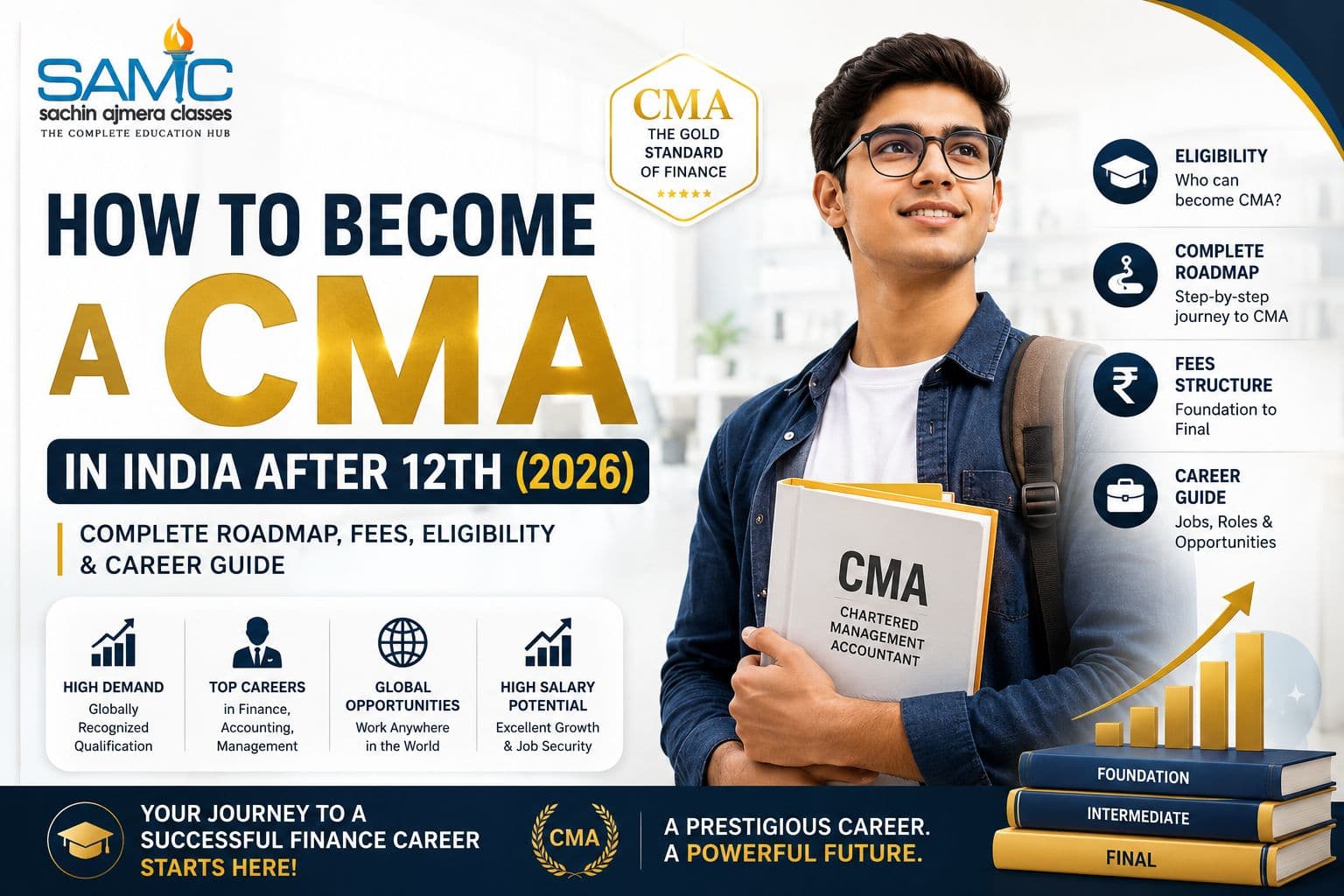
Choosing a career path right after Class 12 feels like a bigger decision than it should be, mostly because nobody hands you a clear map. If you're commerce-minded, good with numbers, and curious about how businesses actually make money (not just record it), CMA is one of the few professional courses you can start immediately after 12th, without waiting for a graduation degree first.
This guide is that map. It covers exactly what CMA is, whether you're eligible right now, how much it costs at each stage, how to register, what to study and when, and what your career and salary actually look like once you qualify - all based on ICMAI's current 2026 structure.
Quick Answer
CMA (Cost and Management Accountant) is a professional certification by ICMAI that you can start right after Class 12 in any stream. It has three levels - Foundation, Intermediate, and Final - takes roughly 3-4 years to complete with consistent preparation, costs about ₹54,100 in total ICMAI registration fees, and leads to starting salaries of ₹4-8 LPA, rising to ₹20-40+ LPA in senior roles.
| Factor | Details |
|---|---|
| Eligibility | Passed Class 10 and 12 (any stream) for Foundation; graduates get direct entry to Intermediate |
| Duration | 3-4 years (Foundation to Final), with 3 years of mandatory practical training required for membership |
| Fees (ICMAI registration only) | ~₹54,100 total (Foundation ₹6,000 + Inter ₹23,100 + Final ₹25,000) |
| Salary | ₹4-8 LPA for freshers, ₹10-18 LPA mid-level, ₹20-40+ LPA senior roles |
| Career Scope | Cost accounting, FP&A, internal audit, corporate finance, government and PSU roles |
| Entrance Exam | No separate entrance exam - direct registration based on eligibility |
| Difficulty Level | Moderate to high - calculation-heavy at Inter/Final, MCQ-based at Foundation |
| Average Study Time | 6-8 months per level with consistent daily preparation |
What is CMA?
What does CMA stand for and what does a CMA do? CMA stands for Cost and Management Accountant, a professional certification focused on cost accounting, budgeting, financial planning, and strategic decision-making within businesses. A CMA helps organizations control costs, plan budgets, and use financial data to support management decisions - going beyond basic bookkeeping into business strategy.
Unlike a general commerce degree, CMA is a specialized, industry-recognized qualification. It sits alongside CA (Chartered Accountancy) and CS (Company Secretary) as one of India's three major commerce-based professional certifications, but focuses specifically on cost management and internal decision-support rather than statutory audit or company law compliance.
Who Conducts the CMA Course?
The CMA course in India is conducted by the Institute of Cost Accountants of India (ICMAI), a statutory body established under an Act of Parliament. ICMAI designs the syllabus, conducts exams twice a year (June and December), and grants the CMA designation upon successful completion of all three levels plus mandatory practical training.
Who Should Choose CMA?
CMA is a strong fit if you enjoy working with numbers, want a professional qualification without committing to a full-time degree first, and are interested in how businesses actually control costs and plan finances rather than just record transactions. It particularly suits students who want to enter manufacturing, FP&A, or corporate finance roles, since costing expertise is central to those industries.
It may be less suited to students specifically drawn to statutory audit or legal compliance work - those interests usually align better with CA or CS respectively. If you're unsure which of the three fits you best, our detailed CA vs CMA comparison breaks down the practical differences in course structure, career paths, and day-to-day work.
Can Students Do CMA Immediately After Class 12?
Yes. Students can register for CMA Foundation immediately after passing Class 12 from any recognized board, in any stream - commerce, science, or arts. There is no requirement to wait for a graduation degree, and no separate entrance exam is needed; eligibility is based purely on having passed Class 10 and 12.
Eligibility Criteria
| Level | Eligibility |
|---|---|
| CMA Foundation | Passed Class 10 and Class 12 (any stream) from a recognized board |
| CMA Intermediate (via Foundation) | Cleared CMA Foundation |
| CMA Intermediate (direct entry) | Graduate in any discipline (excluding Fine Arts), skipping Foundation entirely |
| CMA Final | Cleared both groups of CMA Intermediate |
Graduates who enter directly at the Intermediate level save both the Foundation registration fee and roughly 6-8 months of preparation time. For the complete eligibility breakdown, including diploma-holder and provisional-admission scenarios, see our detailed CMA course eligibility guide.
Step-by-Step Roadmap After 12th
- Register for CMA Foundation on the ICMAI portal right after your Class 12 results are declared.
- Prepare for 6-8 months across all four Foundation papers, focusing on accuracy since the exam is fully MCQ-based.
- Clear CMA Foundation and immediately register for CMA Intermediate to maintain preparation momentum.
- Prepare for both Intermediate groups together over roughly 8-10 months rather than splitting them across separate attempts.
- Clear CMA Intermediate and register for CMA Final.
- Begin mandatory practical training (articleship-equivalent) alongside or after Intermediate, as required by ICMAI norms.
- Prepare for and clear CMA Final, typically over another 8-10 months.
- Complete practical training requirements and apply for ICMAI membership to officially use the CMA designation.
Registration Process
How do I register for CMA Foundation online? Visit icmai.in, click the "Students" tab, select "Admission," choose "Online Admission," fill in your personal and academic details, upload the required documents, pay the registration fee online, and submit the form to receive your registration confirmation.
- Go to the official ICMAI website (icmai.in).
- Click on "Students" in the main menu, then "Admission."
- Select "Online Admission" and choose the course level (Foundation or Intermediate for direct entry).
- Create a login account and enter personal, address, and qualification details.
- Upload scanned documents (mark sheets, photo, signature, ID proof).
- Pay the registration fee via net banking, debit/credit card, or UPI.
- Submit the form and save the acknowledgment receipt for your records.
Documents Required
- Class 10 and Class 12 mark sheets (or graduation degree/marksheet for direct entry to Intermediate)
- Recent passport-size photograph
- Scanned signature
- Valid ID proof (Aadhaar, PAN, or equivalent)
- Category certificate, if applicable, for fee concessions
Registration Fees
| Level | ICMAI Registration Fee |
|---|---|
| CMA Foundation | ₹6,000 |
| CMA Intermediate | ₹23,100 |
| CMA Final | ₹25,000 |
| Total (approximate) | ₹54,100 |
Exam application fees are separate and paid per session (per group, per attempt), typically ranging from roughly ₹1,200 for Foundation to ₹1,800-3,200 for Intermediate/Final depending on whether you're appearing for one or both groups. This registration fee does not include coaching, study material, or exam-form costs across multiple attempts - for the complete real-world cost picture, see our detailed CMA course fees breakdown.
Expert Tip: Looking only at the registration fee gives an incomplete cost picture. Plan for exam fees each session, study material, and coaching costs separately when budgeting for your full CMA journey.
Latest CMA Course Structure
Foundation
Four papers, 100 marks each, fully MCQ-based with no negative marking. Covers fundamentals of accounting, laws and ethics, business mathematics, and business economics. This level builds the base for everything that follows.
Intermediate
Eight papers across two groups, covering costing, financial management, direct and indirect taxation, and corporate law, with a mix of objective and descriptive questions. This is where the syllabus jumps significantly in both depth and volume compared to Foundation.
Final
Eight papers across two groups at an advanced level, covering strategic cost management, corporate financial reporting, strategic performance management, and specialized electives. Final also tests case-study-based application, not just theoretical recall.
For a full chapter-wise breakdown across all three levels, see our complete CMA course syllabus guide, and specifically for the Foundation-level paper pattern, our CMA Foundation syllabus guide.
Complete Duration
| Stage | Typical Duration |
|---|---|
| Foundation preparation | 6-8 months |
| Intermediate preparation (both groups together) | 8-10 months |
| Final preparation (both groups together) | 8-10 months |
| Practical training (can overlap with Inter/Final prep) | 3 years (mandatory for membership) |
| Total (Foundation to CMA membership) | Roughly 3-4 years with consistent first-attempt clearance |
Can Students Complete CMA With B.Com?
Yes, and it's a common combination. Students often pursue CMA alongside a regular B.Com degree, since CMA's exam sessions (June and December) and B.Com semester schedules can generally be managed together with disciplined time management. Graduates with a B.Com also qualify for direct entry into CMA Intermediate, skipping Foundation entirely.
Can Students Prepare Without Coaching?
Self-study is possible, particularly for disciplined students with a strong commerce background, but it comes with real trade-offs: slower doubt resolution, less structured pacing, and a higher risk of drifting off the actual ICMAI exam pattern. Our guide on the real benefits of CA/CMA coaching in India breaks down exactly where structured coaching tends to save the most time and reduce repeat attempts.
Study Plan for Beginners
30-Day Plan (Getting Started)
- Week 1: Read through the full Foundation syllabus and ICMAI study material index to understand scope.
- Week 2-3: Begin Accounting and Business Laws chapters, building a daily 2-3 hour study habit.
- Week 4: Attempt your first chapter-wise MCQ tests to gauge where you stand.
90-Day Plan (Building Momentum)
- Month 1: Complete Accounting and Laws & Ethics fundamentals.
- Month 2: Move into Business Mathematics and Statistics, alongside continued revision of Month 1 topics.
- Month 3: Complete Business Economics, start full-syllabus mock tests, and identify weak chapters for focused revision.
1-Year Roadmap (Foundation to Intermediate Start)
- Months 1-6: Complete Foundation preparation with weekly tests and monthly full mocks.
- Month 7: Sit for the Foundation exam.
- Months 8-12: Begin Intermediate preparation immediately after results, starting with the numerically heavier papers (Costing, Financial Management) alongside theory subjects.
Common Mistakes Students Make
| # | Mistake | Fix |
|---|---|---|
| 1 | Delaying registration after 12th results | Register as soon as results are out to avoid losing preparation months |
| 2 | Treating Foundation as "easy" and under-preparing | Foundation's MCQ format punishes inaccuracy just as much as weak concepts |
| 3 | Skipping mock tests until the final month | Start timed mocks at least 6-8 weeks before every exam |
| 4 | Splitting Intermediate/Final groups unnecessarily | Attempting both groups together generally saves 6-8 months overall |
| 5 | Ignoring practical training until after Final | Practical training can often overlap with Inter/Final prep - starting early avoids delays to membership |
| 6 | Not building ERP/Excel skills during preparation | These skills directly affect job-readiness and starting salary after qualifying |
| 7 | Comparing personal timeline to social media toppers | Every student's starting point and pace differ; focus on your own consistent progress |
Skills Required
- Comfort with numbers and basic mathematics, since Foundation and Intermediate are calculation-heavy.
- Consistent daily study discipline, given the exam is spread across three levels over several years.
- Analytical thinking - CMA increasingly tests application (case studies, scenario-based questions), not just recall.
- Basic English communication skills, since descriptive papers at Intermediate/Final require clear written answers.
Best Books and Study Material
The ICMAI official study material is mandatory and should form the base for every level. Supplementing it with a solved-problems practice manual and access to curated notes significantly improves numerical speed and accuracy. Our detailed guide on best books for CMA Foundation preparation breaks this down subject by subject, and SAC also provides free CMA study material covering chapter-wise notes and revision resources.
Best Preparation Strategy
- Build a fixed daily and weekly study schedule rather than studying only when motivated.
- Prioritize high-weightage chapters early, then layer in smaller topics.
- Solve problems repeatedly rather than just reading theory, especially for Costing and Financial Management.
- Take weekly low-stakes tests to surface weak areas while there's still time to fix them.
- Start full-length, timed mock tests at least 6-8 weeks before every exam.
Exam Pattern
| Level | Papers | Format | Marks |
|---|---|---|---|
| Foundation | 4 | Fully MCQ-based, no negative marking | 100 per paper |
| Intermediate | 8 (2 groups) | Mix of objective and descriptive | 100 per paper |
| Final | 8 (2 groups) | Descriptive, case-study based | 100 per paper |
Passing Criteria
What is the passing criteria for CMA exams? Candidates need a minimum of 40% marks in each individual paper and an aggregate of 50% across all papers in a group to pass. Falling short in even one paper, despite a strong aggregate, results in not clearing that group.
Career Opportunities
CMAs work across cost accounting, financial planning and analysis (FP&A), internal audit, budgeting, treasury, and corporate finance roles, spanning manufacturing, BFSI, FMCG, IT/GCC, consulting, and government/PSU sectors. The qualification is particularly valued in industries where cost control and financial decision-support are central to business operations, such as manufacturing.
Highest Paying Jobs
| Job Role | Indicative Salary Range |
|---|---|
| FP&A Manager | ₹15-30 LPA |
| Financial Controller | ₹20-40 LPA |
| Finance Manager | ₹15-28 LPA |
| Cost Controller | ₹10-20 LPA |
| Internal Audit Manager | ₹12-25 LPA |
| Chief Financial Officer (CFO) | ₹40 LPA and above |
Salary in India
Indicative CMA salary ranges in India (aggregated from public job portals and salary surveys, not an official ICMAI figure): freshers typically start between ₹4-8 LPA, mid-level professionals (3-7 years) earn ₹10-18 LPA, and senior professionals (8-15 years) in managerial or controllership roles earn ₹20-40 LPA. Our detailed CMA salary and career scope guide covers the full breakdown by city, industry, and role.
Salary Abroad
CMAs with additional certifications like CMA (US) or CFA, or with strong MNC/GCC experience in India, can access international roles, particularly in the Middle East (UAE, Saudi Arabia), where Indian finance professionals are widely employed in corporate finance and audit functions. International packages vary significantly by country, role, and employer, and typically require a few years of India-based experience first.
Government Jobs
CMAs are eligible for select government and public-sector roles, including positions linked to the Indian Cost Accounts Service (ICAS) and cost audit assignments notified by the Ministry of Corporate Affairs. Government and PSU roles typically offer ₹6-10 LPA depending on department and seniority, along with strong job security.
Private Jobs
Private-sector roles offer a wider salary range depending on company size, city, and industry - from ₹4 LPA in smaller firms or tier-2 cities to ₹15+ LPA in metro-based MNCs, consulting firms, and GCCs for equivalent experience levels.
Top Recruiters
Based on ICMAI's own published campus placement and sector-wise recruiter data, companies that have hired CMA-qualified professionals include Deloitte, KPMG, PwC, Accenture, Infosys, Wipro, Genpact, Hindustan Unilever, Reliance Industries, Indian Oil, GAIL, ONGC, Kotak Mahindra Bank, and Vedanta, spanning consulting, IT/GCC, FMCG, manufacturing, oil & gas, and BFSI sectors.
Future Scope
Demand for CMAs is expected to keep growing through 2026 and beyond, driven by expanding GCC (Global Capability Center) hiring for finance and reporting roles, rising demand for FP&A and analytics-driven finance professionals, and continued reliance on cost management expertise in India's manufacturing sector. Professionals who pair CMA with ERP (SAP FICO) and data-analytics skills are particularly well-positioned for this growth.
Is CMA Better Than CA?
Neither is universally "better" - the right choice depends on career interest. CMA suits students drawn to cost management, FP&A, and strategic finance, while CA suits students drawn to statutory audit, taxation, and compliance-heavy work. CMA is also generally faster to complete and less expensive in total fees. Our full CA vs CMA comparison covers this in depth, including a look at realistic attempt patterns for both courses.
CA vs CMA
| Factor | CA | CMA |
|---|---|---|
| Conducting Body | ICAI | ICMAI |
| Focus Area | Audit, taxation, statutory compliance | Cost management, FP&A, strategic finance |
| Typical Duration | 4-5 years | 3-4 years |
| Approximate Total Fees | Similar overall, slightly role-dependent | ~₹54,100 (ICMAI registration only) |
| Career Fit | Audit firms, tax practice, statutory roles | Manufacturing, FP&A, corporate finance |
Is CMA Better Than MBA?
CMA and MBA serve different purposes. CMA is a focused, exam-based professional certification in cost and management accounting, typically less expensive and completed earlier than an MBA. An MBA offers broader business management exposure and stronger networking/placement infrastructure at top B-schools, but comes with significantly higher costs and, for most colleges, less specialized financial/costing depth than CMA.
CMA vs MBA
| Factor | CMA | MBA (Finance) |
|---|---|---|
| Typical Cost | ~₹54,100 (ICMAI fees) + coaching | ₹5-25+ lakhs depending on institute |
| Typical Duration | 3-4 years (can run alongside graduation) | 2 years (after graduation) |
| Depth in Costing/Finance | High, specialized | Moderate, broader business focus |
| Networking/Placement Infrastructure | Institute-facilitated campus placement | Strong at top-tier B-schools |
CMA vs CS
| Factor | CMA | CS |
|---|---|---|
| Conducting Body | ICMAI | ICSI |
| Focus Area | Cost management, financial planning | Company law, corporate governance, compliance |
| Career Fit | Manufacturing, FP&A, corporate finance | Legal/compliance roles, company secretarial work |
Foundation vs Inter vs Final
| Factor | Foundation | Intermediate | Final |
|---|---|---|---|
| Papers | 4 | 8 (2 groups) | 8 (2 groups) |
| Format | MCQ only | Objective + Descriptive | Descriptive, case-study based |
| Typical Prep Time | 6-8 months | 8-10 months | 8-10 months |
| Fee | ₹6,000 | ₹23,100 | ₹25,000 |
Government vs Private Jobs
| Factor | Government/PSU | Private Sector |
|---|---|---|
| Indicative Salary | ₹6-10 LPA | ₹4-15+ LPA (wider range) |
| Stability | High | Varies by company |
| Growth Speed | Structured, slower | Can be faster in MNCs/consulting |
Salary Comparison (Experience-Wise)
| Experience | Indicative Salary Range |
|---|---|
| Fresher (0-2 years) | ₹4-8 LPA |
| Mid-level (3-7 years) | ₹10-18 LPA |
| Senior (8-15 years) | ₹20-40 LPA |
| Leadership (15+ years) | ₹40 LPA and above |
Advantages of CMA
- Can be started immediately after Class 12, without waiting for a degree.
- Lower total cost compared to an MBA, with ICMAI registration fees totaling roughly ₹54,100.
- Faster completion timeline (3-4 years) compared to CA (4-5 years).
- Strong specialization in cost management, valued heavily in manufacturing and FP&A roles.
- ICMAI-facilitated campus placement support for qualified students.
Disadvantages
- Calculation-heavy syllabus that requires consistent numerical practice, which can be demanding for students who prefer purely theoretical subjects.
- Less widely recognized outside India compared to global certifications like CMA (US) or CFA, unless paired with additional credentials.
- Requires 3 years of mandatory practical training for membership, which extends the overall timeline to full qualification.
Expert Tips
- Register for Foundation the moment your Class 12 results are declared - every delayed month pushes your entire timeline back.
- Treat Foundation's MCQ format seriously; it's not "easier" than Intermediate, just differently structured.
- Build ERP (SAP FICO) and Excel skills during Intermediate/Final preparation, not after qualifying - it directly affects your starting salary and job readiness.
- Attempt both groups together at Intermediate and Final wherever possible; splitting them usually costs more time than it saves in reduced workload.
Why Students Choose Sachin Ajmera Classes
Starting CMA right after 12th means starting without the structure a college environment usually provides - which is exactly where coaching tends to matter most in the first year. Sachin Ajmera Classes, led by FCA Sachin Ajmera with 23+ years of teaching experience, has maintained a 95% first-attempt success rate across CMA batches, built on structured timetables, weekly tests, and personal mentorship rather than any single shortcut.
Students can review verified AIR results and student success stories to see how this approach has worked for past batches, starting from Foundation right through to Final. SAC offers both offline batches in Jaipur and live online classes for students across India, along with free CMA study material to help you get started even before formally enrolling.
Conclusion
Becoming a CMA after 12th isn't a shortcut career choice - it's a genuinely structured, three-level path that rewards consistency far more than raw talent. Students who register early, treat Foundation with the seriousness it deserves, and build practical skills alongside exam preparation tend to move through all three levels with fewer repeat attempts and stronger starting salaries.
If you're ready to start this journey, explore the complete CMA Foundation to Final program at Sachin Ajmera Classes, book a free demo class to see the teaching approach firsthand, or get in touch with our counseling team to plan your registration and study timeline.
People Also Ask
Can I do CMA and B.Com together?
Yes, many students pursue CMA alongside a regular B.Com degree, managing both since CMA's exam sessions and B.Com semesters can generally be scheduled around each other with disciplined planning.
Is CMA tougher than CA?
Both are demanding, but CA is generally considered to have a larger syllabus volume and lower historical pass rates, while CMA is often seen as comparatively faster to complete with a more numerically-focused syllabus.
What is the minimum age to register for CMA Foundation?
There is no separate minimum age requirement beyond having passed Class 10 and Class 12 from a recognized board, which typically means most students register around 17-18 years of age.
Can arts or science students do CMA?
Yes, CMA Foundation is open to students from any stream - commerce, science, or arts - as long as they've passed Class 10 and 12 from a recognized board.
How many attempts does it usually take to clear all CMA levels?
Most students clear each level within one to three attempts with consistent preparation, though this varies significantly based on study discipline and whether coaching support is used.
Is CMA recognized internationally?
ICMAI's CMA is primarily recognized within India, though it carries growing recognition through mutual arrangements and is often paired with CMA (US) for stronger international mobility.
What is the difference between CMA India and CMA USA?
CMA India (ICMAI) is a three-level Indian qualification focused on Indian accounting and tax law, while CMA USA (IMA) is a two-part global certification focused on US-oriented management accounting standards.
Do I need coaching to clear CMA in the first attempt?
Coaching isn't mandatory, but structured coaching typically improves first-attempt clearance rates by providing regular assessment, doubt resolution, and pacing that self-study often lacks.
What happens if I fail a CMA Intermediate group?
You can reattempt the failed group in the next session without needing to clear the other group again, since CMA Intermediate and Final are evaluated group-wise, not as a single combined exam.
Can working professionals pursue CMA?
Yes, since CMA exams are held twice a year and study material is self-paced, many working professionals pursue CMA alongside their jobs, though it typically takes longer without dedicated full-time study hours.
What is the CMA exam frequency?
ICMAI conducts CMA Foundation, Intermediate, and Final exams twice a year, in June and December, at exam centers across India.
Is there negative marking in CMA exams?
CMA Foundation, being fully MCQ-based, has no negative marking as per the current exam pattern; Intermediate and Final are descriptive/objective mixes and don't use negative marking either.
Can I switch from CA to CMA mid-way?
There's no formal "switch," but some subjects have overlapping concepts, and students who've studied CA papers often find certain CMA topics (like costing and tax) faster to grasp due to prior exposure.
What is the CMA practical training requirement?
ICMAI requires 3 years of practical training under a qualified CMA or in an approved organization before a candidate can apply for full membership, though this can often overlap with Intermediate/Final preparation.
Is CMA a good option for students who dislike lengthy theory subjects?
Yes, CMA leans more numerically and analytically compared to CA, making it a reasonable fit for students who prefer calculation-based problem solving over extensive theoretical reading.
What is the average salary hike after clearing CMA Final?
Salary outcomes vary widely by role and company, but professionals who move into FP&A or managerial roles within a few years of qualifying often see meaningfully higher packages than their first job offer.
Can I pursue CMA from a Tier-2 or Tier-3 city?
Yes, ICMAI exams are conducted across numerous centers nationwide, and online coaching options have made structured CMA preparation accessible regardless of city, without needing to relocate.
Does CMA require a specific percentage in Class 12?
No, ICMAI does not prescribe a minimum percentage in Class 12 for CMA Foundation eligibility - passing the exam from a recognized board is sufficient.
What are the renewal requirements after becoming a CMA member?
ICMAI members are typically required to complete continuing education requirements and pay periodic membership fees to maintain active membership status; specific requirements should be confirmed on icmai.in.
Can I pursue CMA and CFA together?
Yes, some students pursue CMA and CFA together or sequentially, particularly those targeting FP&A, investment analysis, or roles that value both cost management and financial analysis expertise.
Is CMA useful for entrepreneurship?
Yes, CMA's focus on costing, budgeting, and financial planning directly supports entrepreneurs and business owners in managing their own venture's finances and pricing decisions.
What is the typical class size or batch structure in CMA coaching?
This varies significantly by institute; students should specifically ask about batch size, doubt-resolution access, and mock test frequency when evaluating coaching options.
Can I get a scholarship or fee waiver for CMA?
ICMAI offers fee concessions for certain categories (such as differently-abled candidates) on registration fees; check the latest concession structure directly on icmai.in.
What is the pass percentage for CMA exams?
ICMAI does not always publish a single consolidated pass percentage figure for every session; historical rates have varied by level and session, and official figures should be checked directly on icmai.in for the specific term.
How is CMA different from a regular B.Com degree?
A B.Com degree provides general commerce education over three years, while CMA is a focused professional certification in cost and management accounting, recognized specifically for finance and costing roles rather than as a general academic degree.
Frequently Asked Questions
1. Can I become a CMA immediately after 12th? Yes, you can register for CMA Foundation immediately after passing Class 12 from any stream, without needing to complete a graduation degree first or clear any separate entrance exam.
2. What is the total fee to become a CMA in India? The total ICMAI registration fee across all three levels is approximately ₹54,100 (Foundation ₹6,000, Intermediate ₹23,100, Final ₹25,000), excluding exam form fees per session, study material, and coaching costs.
3. How long does it take to become a CMA after 12th? It typically takes 3-4 years to complete all three levels with consistent first-attempt clearance, plus 3 years of mandatory practical training for full membership, which can overlap with Intermediate and Final preparation.
4. What is the eligibility for CMA Foundation? Candidates must have passed Class 10 and Class 12 from a recognized board, in any stream, to be eligible for CMA Foundation registration.
5. Can graduates skip CMA Foundation? Yes, graduates in any discipline (except Fine Arts) are eligible for direct entry into CMA Intermediate, skipping the Foundation level entirely and saving both time and the Foundation registration fee.
6. What is the CMA exam pattern? CMA Foundation is fully MCQ-based across 4 papers with no negative marking, while Intermediate and Final each have 8 papers across two groups with a mix of objective and descriptive questions.
7. What is the passing criteria for CMA? Candidates need a minimum of 40% marks in each individual paper and a 50% aggregate across all papers in a group to pass that group.
8. Is CMA better than CA for a commerce student? Neither is universally better - CMA suits students interested in cost management and FP&A, while CA suits students interested in audit, taxation, and statutory compliance work.
9. What is the starting salary after CMA in India? Starting salaries for CMA freshers in India typically range between ₹4-8 LPA, depending on city, industry, and whether the role is with an MNC, PSU, or smaller private firm.
10. Can I do CMA without coaching? Yes, self-study is possible for disciplined students, though structured coaching typically improves first-attempt clearance rates through regular testing and doubt resolution.
11. What documents are needed for CMA registration? You need Class 10 and 12 mark sheets (or graduation certificates for direct entry), a passport-size photograph, a scanned signature, and valid ID proof to complete CMA registration.
12. How many times can I attempt a CMA exam? There is no official cap on the number of attempts for any CMA level, and candidates can reattempt in any subsequent session as long as their registration remains valid.
13. Can I pursue CMA along with a college degree? Yes, many students pursue CMA alongside a B.Com or other graduation degree, managing both through disciplined scheduling around ICMAI's June and December exam sessions.
14. What jobs can I get after completing CMA? CMAs can work in cost accounting, FP&A, internal audit, budgeting, treasury, and corporate finance roles across manufacturing, BFSI, FMCG, IT/GCC, consulting, and government sectors.
15. Does ICMAI offer campus placement? Yes, ICMAI runs a structured campus placement programme for CMA Final-qualified students, connecting them with recruiting companies, though shortlisting and selection depend on each company's own criteria.
16. What is the CMA Foundation syllabus? CMA Foundation covers four papers: Fundamentals of Business Laws and Business Communication, Fundamentals of Financial and Cost Accounting, Fundamentals of Business Mathematics and Statistics, and Fundamentals of Business Economics and Management.
17. Is there an age limit for CMA registration? No, ICMAI does not prescribe a maximum age limit for CMA registration; the only requirement is having passed Class 10 and 12 from a recognized board.
18. What is the difference between CMA Inter and CMA Final? CMA Intermediate covers foundational-to-intermediate level costing, taxation, and financial management concepts, while CMA Final covers advanced, strategic-level topics with heavier case-study application.
19. Can I register for CMA Foundation online? Yes, the entire CMA Foundation registration process is completed online through the ICMAI student portal at icmai.in, including document upload and fee payment.
20. What is the average CMA salary after 5 years of experience? CMAs with around 5 years of experience typically earn ₹10-18 LPA in analytical or managerial roles like FP&A or cost control, depending on industry and city.
21. Is CMA a good career option in 2026? Yes, CMA remains a strong career option in 2026, driven by growing demand for FP&A, cost control, and strategic finance skills across manufacturing, BFSI, and GCC sectors.
22. Can CMA lead to a government job? Yes, CMAs are eligible for select government and PSU roles, including positions linked to the Indian Cost Accounts Service and cost audit assignments under the Ministry of Corporate Affairs.
23. What is the CMA Intermediate registration fee? The CMA Intermediate registration fee is ₹23,100, payable once via ICMAI's online admission portal, separate from exam application fees paid each session.
24. What is the CMA Final registration fee? The CMA Final registration fee is ₹25,000, payable once via ICMAI's online admission portal, in addition to exam application fees paid per session.
25. How does Sachin Ajmera Classes support students starting CMA after 12th? Sachin Ajmera Classes combines structured timetables, weekly tests, and personal mentorship starting from Foundation level, which has supported a 95% first-attempt success rate across CMA batches over 23+ years of teaching.