

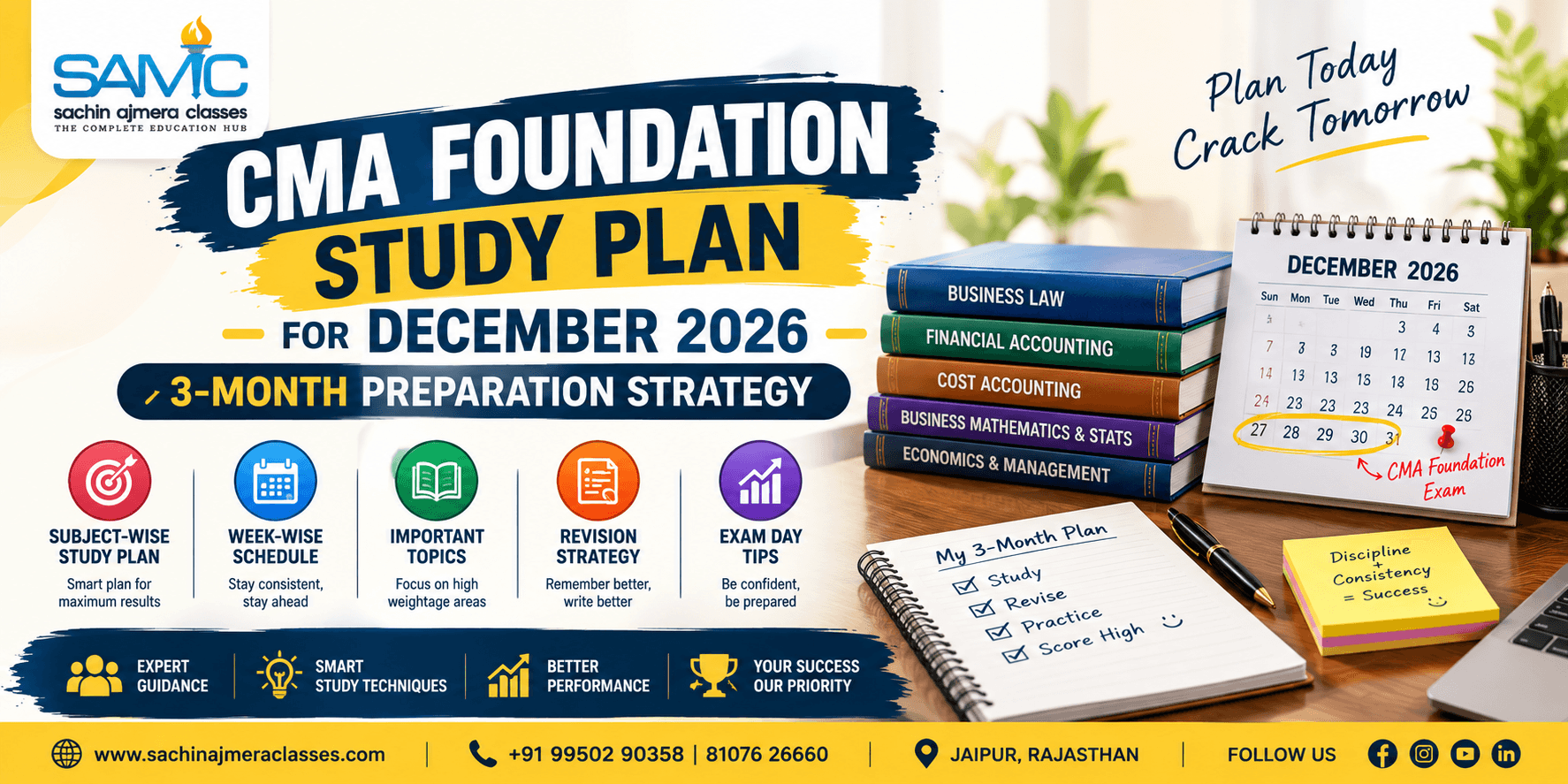
A student preparing for CMA Foundation December 2026 in three months needs a plan that combines four things in sequence: complete syllabus coverage with real conceptual understanding, consistent question practice, previous year paper analysis, and a structured revision-plus-mock-test phase before the exam. Three months is enough time to clear CMA Foundation, but only when the syllabus is finished with real margin left for revision — not when preparation stretches into the final week. This guide lays out exactly how to structure that time, week by week.
Quick Answer: CMA Foundation 3-Month Study Plan
- Month 1: Cover roughly half the syllabus across all four papers, building concepts from scratch — don't skip any paper.
- Month 2: Finish the remaining syllabus and shift into intensive MCQ and numerical practice.
- Month 3: Two full revision cycles, mock tests, and previous year papers — no new topics after Week 9.
- Daily consistency matters more than total hours — a fixed, repeatable daily block beats irregular long sessions.
- Previous year papers should start once 60–70% of the syllabus is covered, not in the final week.
- Last 30 days are for revision and testing only — this is not the time to start new chapters.
- Balance all four papers throughout — there's no exemption at Foundation level, so one weak paper can hold back your entire result.
CMA Foundation December 2026 Exam: What Students Should Know
The Institute of Cost Accountants of India (ICMAI) has officially confirmed the CMA Foundation exam for the December 2026 term. According to ICMAI's released schedule, the CMA Foundation exam will be held on Sunday, December 13, 2026, in two shifts at centre-based, offline OMR mode:
| Session | Timing | Papers Covered |
|---|---|---|
| Morning | 10:00 AM – 12:00 Noon | Paper 1 (FBLC) + Paper 2 (FFCA) |
| Afternoon | 2:00 PM – 4:00 PM | Paper 3 (FBMS) + Paper 4 (FBEM) |
Each paper carries 100 marks (400 total), with 50 MCQs per paper and no negative marking. The exam form deadline (without late fee) is October 14, 2026, with a late-fee window from October 15–21, 2026. The application fee is ₹1,500 for Indian candidates and US$100 for overseas candidates.
These dates are as officially released by ICMAI as of this writing — always cross-check the latest notification on icmai.in before finalising travel or study plans, since institute circulars occasionally see minor updates. For a complete breakdown of exam structure, marking scheme, and passing criteria, see our detailed CMA Foundation exam pattern guide, and for the confirmed date sheet across all three CMA levels, our CMA exam dates 2026 article covers Foundation, Intermediate, and Final together.
Preparation implication: With the exam confirmed for December 13, a student starting in mid-September has almost exactly three months. That timeline is workable only if syllabus completion is treated as a Month 1–2 task, not something left to drift into Month 3.
CMA Foundation 3-Month Study Plan at a Glance
| Month | Main Goal | What to Complete | Practice Target | Revision Target |
|---|---|---|---|---|
| Month 1 | Syllabus + Concepts | ~50% of syllabus across all 4 papers | Topic-wise practice questions after each chapter | Light — same-day recall of what's covered |
| Month 2 | Syllabus Completion + Practice | Remaining ~50% of syllabus | MCQ sets + numerical practice + start previous papers (topic-wise) | First full revision pass begins toward end of month |
| Month 3 | Revision + Mock Tests + Previous Papers | No new topics | Full-length previous papers + mock tests | Two complete revision cycles + final week recall only |
This is a realistic sequencing, not a rigid formula — adjust the exact week boundaries to your own pace, but keep the ratio: roughly two-thirds of your time on syllabus and practice, one-third dedicated to revision and testing.
Month 1: CMA Foundation Syllabus Completion & Concept Building
The first month is about building genuine understanding, not speed. Rushing through concepts here creates gaps that resurface as confusion in Month 3, when there's no time left to fix them.
Week 1: Start with Paper 1 (FBLC) — Indian Contract Act fundamentals — and Paper 3 (FBMS) — Arithmetic basics (ratios, interest). Study type: concept-first, reading the official study material chapter by chapter. Practice target: 10–15 basic questions per topic after each session. Revision target: same-day quick recap, nothing formal yet.
Week 2: Continue Paper 1 (Sale of Goods Act, Negotiable Instruments Act) and begin Paper 2 (FFCA) — Accounting Fundamentals (journal, ledger, trial balance). Practice target: journal and ledger problems daily, law-based MCQs after each Act. Revision target: a short one-page summary per completed topic.
Week 3: Begin Paper 4 (FBEM) — basic microeconomics (demand, supply, elasticity) — alongside continuing Paper 2's Final Accounts preparation. Practice target: numerical accounting problems + economics MCQs. Revision target: revisit Week 1 topics briefly to keep them fresh.
Week 4: Cover Paper 3's core Statistics chapters (measures of central tendency, dispersion) and Paper 4's Theory of Production. Practice target: statistics numerical problems, timed where possible. Revision target: end-of-month recap covering everything studied across all four papers — a full Sunday session works well for this.
Balancing all four papers: Don't dedicate an entire week to one paper and ignore the rest. A workable rhythm is covering 2–3 papers in parallel each week — for example, one law/theory-heavy subject alongside one numerical subject — so no paper falls behind and none feels like an afterthought closer to the exam.
Month 2: Complete Remaining Syllabus + Start Intensive Practice
Week 5: Finish remaining Paper 1 content (Business Communication) and move into Paper 2's Cost Accounting basics (cost sheet format, classification of costs). Practice target: cost sheet problems, communication-based MCQs.
Week 6: Complete Paper 3's remaining Statistics topics (Correlation & Regression, Probability) and Paper 4's Money and Banking chapter. Practice target: full topic-wise MCQ sets, 30–40 questions per sitting.
Week 7: Finish Paper 4's Management Process chapter (planning, organising, leadership, decision-making) — this typically completes the full Foundation syllabus. Practice target: begin solving previous year papers topic-wise (not full papers yet) to test each subject as it's completed.
Week 8: Dedicated practice week — no new syllabus. Focus entirely on MCQ practice across all four papers, identify weak topics through your own practice scores, and begin your first full revision pass covering everything studied in Weeks 1–7.
Using chapter-wise priority without over-relying on it: Once the full syllabus is covered, it helps to know which topics have historically carried more question volume, so revision time gets allocated sensibly. Our CMA Foundation chapter-wise weightage guide breaks this down clearly — but treat it as a revision-sequencing tool, not a shortcut. ICMAI doesn't publish official chapter-level weightage, and every syllabus topic remains examinable, so this should guide the order you revise in, never which topics you skip.
Month 3: Revision, Mock Tests & Exam Preparation
Week 9 — First complete revision: Go through every paper's short notes and formula sheets in sequence. Checklist: (1) re-read every topic summary, (2) redo 10–15 practice questions per topic to confirm retention, (3) flag any topic that still feels shaky for extra attention in Week 10.
Week 10 — Second revision + question practice: Revise flagged weak topics in depth, and solve fresh MCQ sets across all four papers. Checklist: (1) target 100+ MCQs per subject this week, (2) redo any previous mistakes from your error log, (3) time yourself on numerical sections (Paper 2 and Paper 3).
Week 11 — Mock tests + previous year papers: Shift entirely to full-length, timed practice. Checklist: (1) attempt at least one full mock test per paper this week, (2) solve at least 2–3 genuine previous year papers per subject, (3) analyse every mistake the same day you make it — don't let errors pile up unreviewed.
Week 12 — Final revision, weak areas & exam strategy: This is not a week for new practice volume — it's about consolidation. Checklist: (1) revise only your short notes and flagged weak topics, (2) do one final light mock test early in the week, (3) plan your exam-day logistics (admit card, centre location, reporting time), (4) rest properly in the final 2–3 days rather than cramming.
CMA Foundation Daily Study Timetable
There's no single "correct" number of study hours — what matters is whether your plan is consistent and sustainable for three months straight. Below are three realistic structures depending on your availability.
For students with 6 hours/day available
| Time | Activity | Subject/Task | Target |
|---|---|---|---|
| 1.5 hrs | Concept study | New topic (rotate papers daily) | Complete 1 sub-topic thoroughly |
| 1.5 hrs | Numerical practice | Paper 2 or Paper 3 | 20–25 problems |
| 1 hr | MCQ practice | Any paper, rotating | 30–40 MCQs |
| 1 hr | Law/theory revision | Paper 1 or Paper 4 | Short notes + recall |
| 1 hr | Revision of previous day | Mixed | Quick recap + error log update |
For students with 4 hours/day available
| Time | Activity | Subject/Task | Target |
|---|---|---|---|
| 1.5 hrs | Concept study | New topic | Complete 1 sub-topic |
| 1 hr | Numerical or MCQ practice | Rotate by day | 15–20 questions |
| 1 hr | Theory/law revision | Rotate by day | Short notes review |
| 0.5 hr | Recap | Previous day's topics | Quick self-test |
For college/working students with 2–3 hours/day available
| Time | Activity | Subject/Task | Target |
|---|---|---|---|
| 1 hr | Concept study | New topic, smaller chunks | Half a sub-topic if needed |
| 1 hr | Practice | MCQs or numericals, alternating days | 10–15 questions |
| 0.5–1 hr | Revision | Short notes or error log | Quick review |
Students with fewer daily hours will naturally need to extend Month 1 and Month 2 slightly, or start their three-month window a few weeks earlier — the structure and sequencing stay the same regardless of hours available; only the pace changes.
CMA Foundation Subject-wise Preparation Strategy
Business Laws and Business Communication (Paper 1)
Focus on understanding the logic behind each provision rather than memorising sections word-for-word — the Contract Act, Sale of Goods Act, and Negotiable Instruments Act all test application through MCQs, not verbatim recall. Revise using short, self-written summaries of each Act's key provisions. For MCQ practice, focus on distinguishing similar-sounding legal terms (like conditions vs warranties), since that's where most errors happen.
Financial Accounting (Paper 2 — FFCA)
Build the journal-to-final-accounts flow as a single connected process rather than isolated topics — understanding why an entry is made matters more than memorising formats. Practice the same problem types repeatedly until the format becomes automatic (trial balance, trading account, P&L, balance sheet). Keep an error log specifically for accounting — most mistakes here repeat in predictable patterns (like ignoring adjustment entries), and reviewing them directly improves accuracy fastest.
Business Mathematics and Statistics (Paper 3 — FBMS)
This is the most calculation-heavy paper, so timed practice matters more here than anywhere else. Learn formulas alongside the logic behind them, not as isolated things to memorise — this helps when a question is framed slightly differently than what you practiced. Repeated revision is essential for Statistics topics like Central Tendency, Dispersion, and Probability, since formula-based recall fades faster than conceptual understanding.
Business Economics and Management (Paper 4 — FBEM)
Focus on clear conceptual definitions and how they connect — demand-supply theory, market structures, and management principles are far easier to retain when linked to simple real-world examples than when memorised as standalone definitions. Build short revision notes per topic and practice MCQs regularly, since this paper tests conceptual application more than pure recall. A quick weekly revision cycle works better here than long study blocks, given the theory-heavy nature of the content.
How to Use CMA Foundation Chapter Wise Weightage
ICMAI publishes the official syllabus and paper-wise mark distribution (100 marks per paper), but does not release a fixed percentage weightage per chapter under the current Syllabus 2022 structure. What coaching resources — including our own CMA Foundation chapter-wise weightage guide — offer instead is previous-paper trend and preparation-priority analysis: an observation of which topics have carried more consistent question volume across past sessions, not a guarantee of what will appear in December 2026.
Use this the right way: let it help you decide the order in which you revise — high-priority topics get an earlier, more thorough pass — but never let it convince you to skip a "low-priority" topic entirely. Under a fully MCQ-based exam with no negative marking and a 40%-per-paper passing requirement, gaps in any topic can cost marks that add up.
How to Use Previous Year Question Papers Effectively
Previous year papers are most useful when used as a structured process, not solved randomly:
- First understand the concept — don't attempt previous paper questions on a topic you haven't studied yet.
- Solve topic-wise questions first, right after finishing that topic, to test immediate retention.
- Attempt complete papers under timed conditions once a subject's syllabus is fully covered.
- Analyse mistakes the same day — understand why an answer was wrong, not just what the correct answer was.
- Maintain an error notebook — a running log by subject and topic, reviewed weekly.
- Reattempt difficult questions after a week or two, without looking at your previous answers, to confirm the gap is actually closed.
For structured previous-year practice, our previous year CMA Foundation question papers guide covers how to source genuine, syllabus-matched papers. You can also explore our CMA Foundation question bank for structured practice material.
CMA Foundation Revision Strategy
First Revision (end of Month 2): A complete pass through every topic's short notes, done once per paper, focused on confirming you actually remember what was studied — not on solving fresh problems yet.
Second Revision (Week 10): A deeper pass focused specifically on flagged weak areas, combined with fresh MCQ practice to test retention under exam-like conditions.
Final Revision (Week 12): Light, fast-paced review of short notes and formula sheets only — no new problem-solving volume, just confirming recall stays sharp heading into the exam.
Across all three passes: use active recall (test yourself without looking at notes first) over passive re-reading, keep formula revision separate and frequent for Paper 3, rely on your own short notes rather than re-reading full study material each time, do regular MCQ practice to keep speed up, maintain your mistake notebook as the primary revision tool for weak areas, and include timed tests in every revision cycle from Week 9 onward.
CMA Foundation Mock Test Strategy
When to start: Begin full-length mock tests once you've completed at least one full revision pass — typically Week 9 or 10, not earlier. Mocks taken before the syllabus is complete mostly measure what you haven't studied yet, which isn't useful diagnostic information.
How frequently: Aim for at least one full mock test per paper during Week 11, alongside previous year papers. More frequent mocks in the final two weeks help build exam-day stamina and pacing.
How to analyse scores: A mock test score only becomes useful once you review why each question was missed — was it a concept gap, a calculation error, or a time-pressure mistake? Each of these needs a different fix.
Identifying weak areas: Track scores by topic, not just overall paper score. A 70% overall score can still hide one chapter where you're consistently scoring below 40% — that chapter needs focused attention before exam day.
Why analysis matters more than mock volume: Taking ten mocks without reviewing mistakes teaches you very little beyond your current score. Taking four mocks with thorough, honest review of every error builds far more genuine improvement.
How to Score 80+ in CMA Foundation
Students aiming for 80+ can use the following strategy — this isn't a guarantee, but a structured approach that supports high scoring:
- Complete the full syllabus — high scores require confidence across all topics, not just the "important" ones.
- Prioritise high-value topics for extra revision passes, based on syllabus structure and previous-paper trends, without skipping the rest.
- Solve previous papers extensively in the final month, across all four subjects.
- Revise repeatedly using the three-pass system outlined above, rather than a single read-through.
- Improve accuracy through timed MCQ practice — since there's no negative marking, every attempted question matters, but silly mistakes on known concepts cost avoidable marks.
- Reduce silly mistakes by reviewing your error log specifically for careless errors (misread questions, calculation slips) versus genuine gaps.
- Take timed tests regularly in the final month to build both speed and composure under pressure.
- Maintain consistency — three months of steady daily effort outperforms sporadic long study sessions before the exam.
CMA Foundation Last 30 Days Preparation Strategy
Days 1–10 (First revision): Complete a full pass through short notes and formula sheets across all four papers. No new topics. Light MCQ practice alongside.
Days 11–20 (Question papers + weak areas): Solve previous year papers extensively, subject by subject. Use scores to identify and target weak chapters specifically — this is the window to close real gaps, not just revise what's already strong.
Days 21–25 (Mock tests + analysis): Attempt full-length mock tests under strict timed conditions, ideally in the same time slots as your actual exam sessions (morning and afternoon). Analyse every mock immediately — same-day review, not delayed.
Days 26–30 (Final revision): Light, fast recall-only revision. Review your error notebook one final time, confirm exam-day logistics (admit card, centre, reporting time), and prioritise rest over last-minute cramming in the final 2–3 days.
If your exam falls on a different date than the officially confirmed December 13, 2026 schedule, shift this 30-day structure to end exactly on your exam day — the sequence matters more than the specific calendar dates.
Common Mistakes Students Make During CMA Foundation Preparation
- Studying without a timetable — leads to uneven coverage and last-minute panic on neglected topics.
- Ignoring difficult subjects — usually Law or Economics for numerically-inclined students, or Maths/Statistics for others — until it's too late to fix.
- Postponing revision — treating revision as something to "get to later" instead of scheduling it from Month 2 onward.
- Only reading theory — without solving questions, retention and application ability both stay weak.
- Not solving enough questions — MCQ exams reward speed and pattern recognition, which only comes from practice volume.
- Depending entirely on predicted or "important" questions — no source, including this guide, can guarantee what will appear on exam day.
- Taking mocks without analysis — a wasted opportunity if the mistakes aren't reviewed and understood.
- Changing resources repeatedly — switching between multiple books or question banks instead of mastering one reliable source wastes time better spent on practice.
Frequently Asked Questions
1. How should I prepare for CMA Foundation December 2026?
Build a three-month plan covering syllabus completion in Months 1–2, followed by intensive revision, mock tests, and previous year papers in Month 3. Balance all four papers throughout rather than focusing on one at a time, since there's no exemption at the Foundation level.
2. Is 3 months enough for CMA Foundation?
Yes, three months is generally sufficient if the syllabus is completed within the first two months, leaving the third month fully dedicated to revision and testing. It becomes insufficient only when syllabus completion drags into the final weeks.
3. How many hours should I study for CMA Foundation?
There's no fixed number that applies to everyone — students with 6 hours, 4 hours, or 2–3 hours daily can all succeed with a structured, consistent plan. Consistency across three months matters more than hitting an arbitrary hourly target.
4. What is the best CMA Foundation study plan?
A plan that completes the full syllabus by the end of Month 2, uses Month 3 for structured revision and mock tests, and balances practice across all four papers throughout — rather than one that leaves revision or any single paper for the last minute.
5. How can I complete CMA Foundation syllabus in 3 months?
Split the syllabus roughly in half across Months 1 and 2, studying 2–3 papers in parallel each week rather than one paper at a time, so no subject is left behind as the exam approaches.
6. What should I study first for CMA Foundation?
Start with foundational topics that other chapters build on — Indian Contract Act in Paper 1, Accounting Fundamentals in Paper 2, and basic Arithmetic in Paper 3 — alongside beginning Business Economics concepts in Paper 4.
7. How should I divide time between the four CMA Foundation subjects?
Since all four papers carry equal marks (100 each) with no exemption system, divide study time roughly evenly, adjusting slightly based on your personal strengths — spend a bit more time on subjects you find harder, without neglecting the ones you find easier.
8. When should I start solving previous year papers?
Begin topic-wise previous year practice once each topic is completed (around Month 2), and shift to full-length, timed previous papers once the entire syllabus for that subject is covered — typically by Week 8 or 9.
9. When should I start taking CMA Foundation mock tests?
Start full-length mock tests after completing at least one full revision pass, typically in Week 9 or 10 of a three-month plan — earlier mocks mostly reveal syllabus gaps rather than genuine exam readiness.
10. How many times should I revise the CMA Foundation syllabus?
Aim for at least two to three complete revision passes: a first full revision at the end of Month 2, a second focused pass in Week 10, and a final light recall-only revision in the last week before the exam.
11. How can I score 80+ in CMA Foundation?
Students aiming for 80+ can focus on complete syllabus coverage, extensive previous paper practice, repeated revision, and reducing careless errors through timed testing — this supports strong scoring but isn't a guarantee.
12. Which CMA Foundation subjects require the most practice?
Paper 3 (Business Mathematics and Statistics) typically needs the most repeated numerical practice due to its calculation-heavy nature, while Paper 2 (Accounting) needs a steady mix of concept and calculation practice.
13. How should I prepare during the last 30 days?
Use Days 1–10 for a full revision pass, Days 11–20 for previous year papers and targeting weak areas, Days 21–25 for mock tests with same-day analysis, and Days 26–30 for light final revision and rest.
14. Are previous year papers important for CMA Foundation?
Yes — since ICMAI doesn't publish official chapter-wise weightage, previous year papers are the most reliable way to understand real question patterns and difficulty level ahead of the exam.
15. How can I identify important CMA Foundation topics?
Use a combination of the official syllabus structure and previous-paper trend analysis — our chapter-wise weightage guide covers this in detail — while still preparing every topic in the syllabus.
16. Can a college student prepare for CMA Foundation in 3 months?
Yes, with a realistic 2–3 hours/day plan structured consistently across the full three months — the daily volume is lower, but the sequencing of concept-building, practice, and revision stays the same.
17. What should I do if my syllabus is still incomplete one month before the exam?
Prioritise finishing the remaining syllabus in the first 1–2 weeks of that final month using focused, high-intensity study, then compress revision into a shorter but still structured cycle — skipping revision entirely is riskier than compressing it.
18. How should I revise CMA Foundation before the exam?
Use a three-pass system — a full revision after syllabus completion, a focused second pass on weak areas, and a final light recall-only revision in the last week — combined with active recall, formula review, and timed MCQ practice throughout.
Explore More CMA Foundation Resources
A study plan works best when paired with the right resources at each stage. If you're building your preparation timeline, these guides cover the details this article referenced:
- CMA Foundation Syllabus 2026 — full topic-by-topic content for all four papers
- CMA Foundation Exam Pattern 2026 — marks, question types, and marking scheme
- CMA Foundation Passing Marks 2026 — exact criteria to clear each paper
- CMA Foundation Chapter Wise Weightage 2026 — priority topics based on syllabus and trend analysis
- Previous Year CMA Foundation Question Papers — how to source and use genuine papers
- Best Books for CMA Foundation Preparation — subject-wise resource recommendations
- CMA Course Eligibility 2026 and CMA Course Fees 2026
If you'd prefer structured guidance instead of navigating this timeline alone — with regular tests, doubt-clearing, and mentorship built in — explore our CMA Foundation Coaching in Jaipur and online. You're also welcome to practice directly with our Question Bank as you work through this plan.